
ACA Leadership Symposium examines growth, innovation and advocacy
Last update: Thursday February 19, 2026, 5:28 p.m. Central European Time
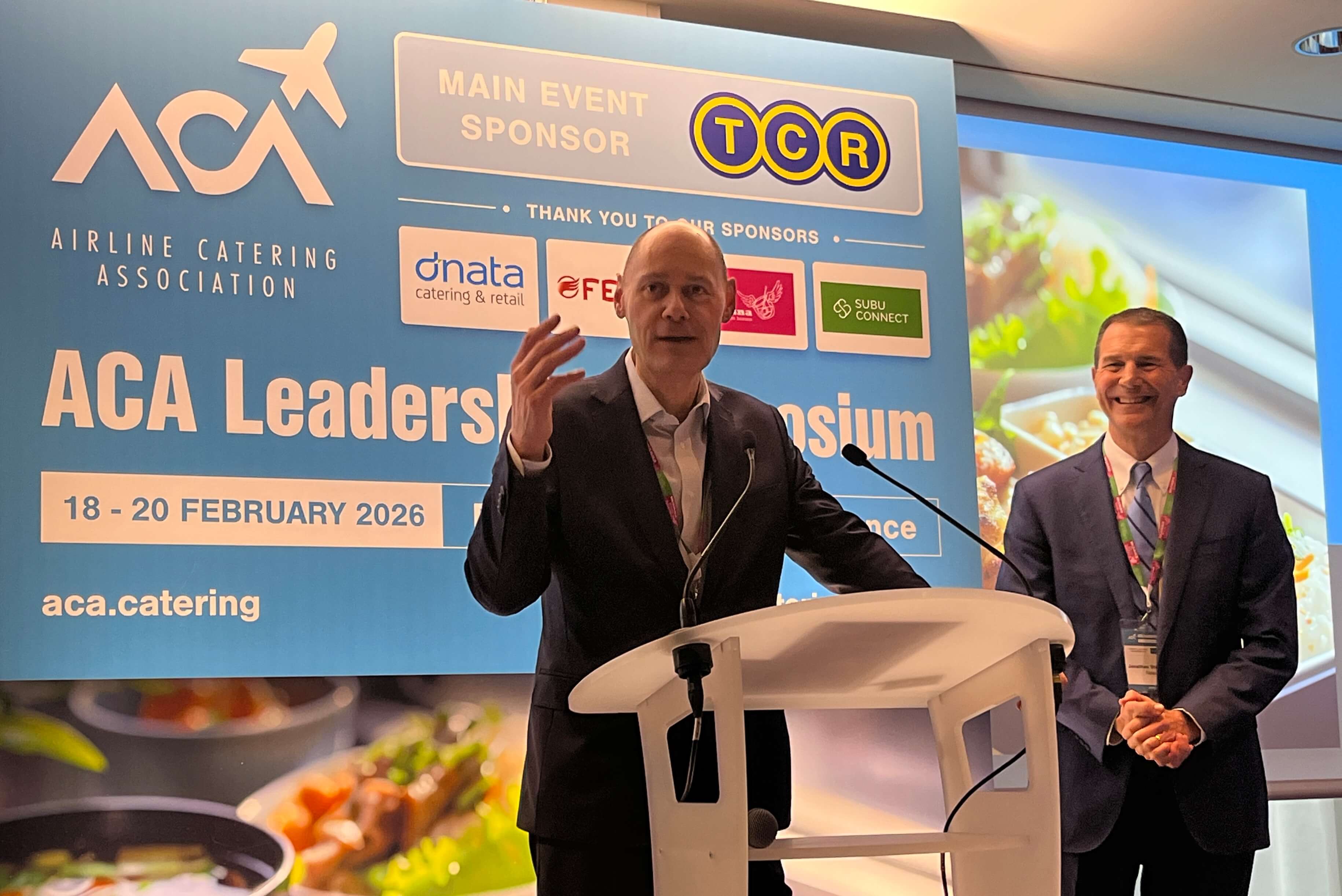
ACA Managing Director Fabio Gamba (left) and Jonathan Stent-Torriani, Chairman of Newrest and current ACA President, during the welcome address in Toulouse, France
The Airline Catering Association (ACA) Leadership Symposium is underway in Toulouse today, drawing a larger and more globally diverse audience than last year and reinforcing the association’s growing influence within the inflight catering sector.
A homecoming in Toulouse
Opening the event, Jonathan Stent-Torriani, Chairman of Newrest and current ACA President, welcomed delegates to what he described as his “second home” — the city where Newrest was founded three decades ago.
Reflecting on the company’s 30-year journey, Stent-Torriani recalled its beginnings as a 12-person operation located beside Toulouse-Blagnac Airport. Today, Newrest serves airline customers across the globe, a trajectory that mirrors the broader internationalization and consolidation of the catering industry itself.
He noted that attendance has surpassed last year’s inaugural Leadership Symposium in Amsterdam, The Netherlands, attributing the growth to both renewed industry momentum and ACA’s increasing recognition as a credible, unified advocacy voice. In a moment that underscored the association’s evolution, Stent-Torriani also confirmed that his term as President concludes this afternoon, with a new President set to be announced during the event — and, by tradition, next year’s host city likely to follow the new leader’s home base.
ACA Managing Director Fabio Gamba followed with remarks thanking Newrest — one of ACA’s earliest supporters when the association was founded seven years ago — and outlining the day’s revised format. Building on lessons from last year’s edition, the program combines keynote insight, interactive “Dragon’s Den”-style galley innovation pitches, networking over lunch and three focused panel discussions. A state of the industry address will round out the formal sessions before delegates gather for an evening reception and dinner. Tomorrow, attendees will visit the Airbus facility in Toulouse — an experience positioned as a rare opportunity to connect catering strategy directly with aircraft manufacturing and onboard design.
From the origins of travel catering to its digital future
The morning keynote was delivered by Nicolas Dubois, Director General of Civil Aviation Safety at Direction Générale de l’Aviation Civile (DGAC). His address placed airline catering within a broader historical and regulatory context, tracing the roots of onboard service back to the earliest days of mass transport on rail and sea.
“Ever since humans began to travel, food logistics have been key, and feeding travelers has always required very specific organization,” Dubois said. “Catering became symbol of luxury and glamour associated with travel.”
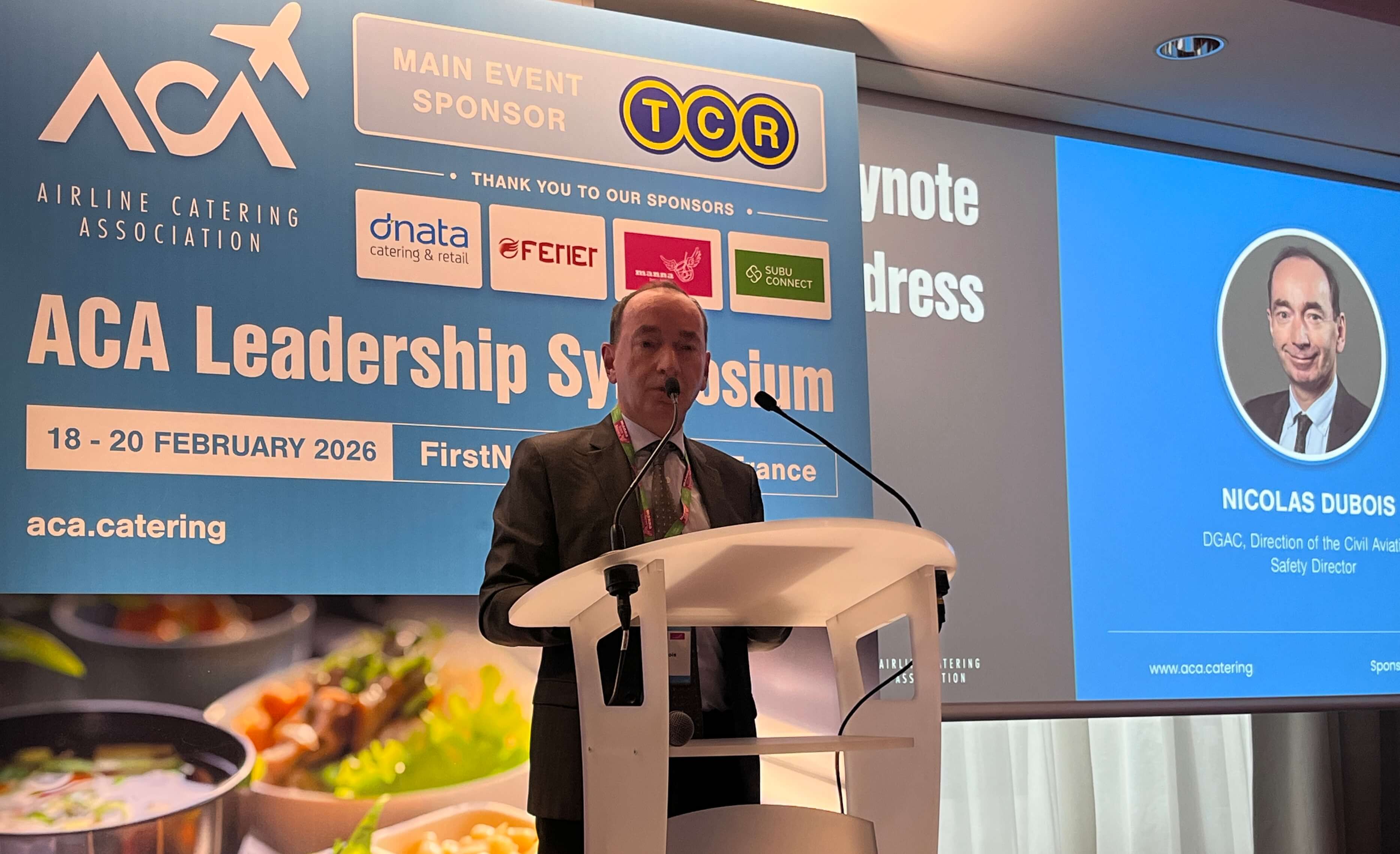
Nicolas Dubois, Director General of Civil Aviation Safety at Direction Générale de l’Aviation Civile, delivers keynote speech
He highlighted the structural complexity of airline catering today — operating at the intersection of aviation safety regulation, food safety compliance, security requirements and environmental policy. This regulatory “turbulence,” as he described it, presents ongoing challenges but also underscores the strategic importance of the sector within the aviation ecosystem.
Looking ahead, Dubois identified technology, data and personalization as the primary drivers of future development. In an era defined by tighter operational margins and evolving passenger expectations, digitalization and data-driven forecasting are expected to reshape everything from menu design and provisioning to waste reduction and supply chain traceability.
In a lighter moment, Dubois noted that while he often speaks publicly about safety, security and sustainability, addressing food in France carried its own particular resonance — drawing appreciative recognition from the audience.
He also reflected on ACA’s seven-year journey, calling seven the “age of reason,” and suggesting that the association has reached a new stage of institutional maturity — one in which its advocacy voice is increasingly heard at global regulatory and policy levels.
Industry alignment in focus
As the day progresses with the “Pitch Galley” and panel discussions, early themes emerging from Toulouse point to an industry balancing heritage and modernization: respecting the legacy of service that defined air travel’s golden age while embracing the data, sustainability frameworks and operational precision required for its next chapter.
This year’s sponsors include TCR, dnata, Ferier, Mana from Heaven and Subu Connect, with PAX International serving as official media partner. Follow PAX International on Instagram and LinkedIn for continuing coverage and insights from Toulouse.
Pitch galley presentations
Closing out the morning sessions was a new addition to this year’s program, the first-ever “Pitch Galley.”
Designed as a fast-paced showcase format, the segment featured 14 seven-minute presentations, giving participating companies a rare opportunity to introduce their solutions directly to an audience of airline and catering decision-makers — many for the first time.
“This is something we are told is lacking, so this is the perfect opportunity for them to introduce their companies to you and for you to get to know them,” explained Gamba.
The presentations were grouped into four key categories reflecting the breadth of today’s onboard ecosystem:
- Food & product inputs: food and beverage supply, packaging and disposables
- Culinary, design & service experience: culinary design and menu development, onboard retail and ancillary services
- Equipment, logistics & operations: galley equipment and trolleys, logistics and cold-chain transport
- Systems & assurance: software, IT and digital solutions, quality, food safety and testing
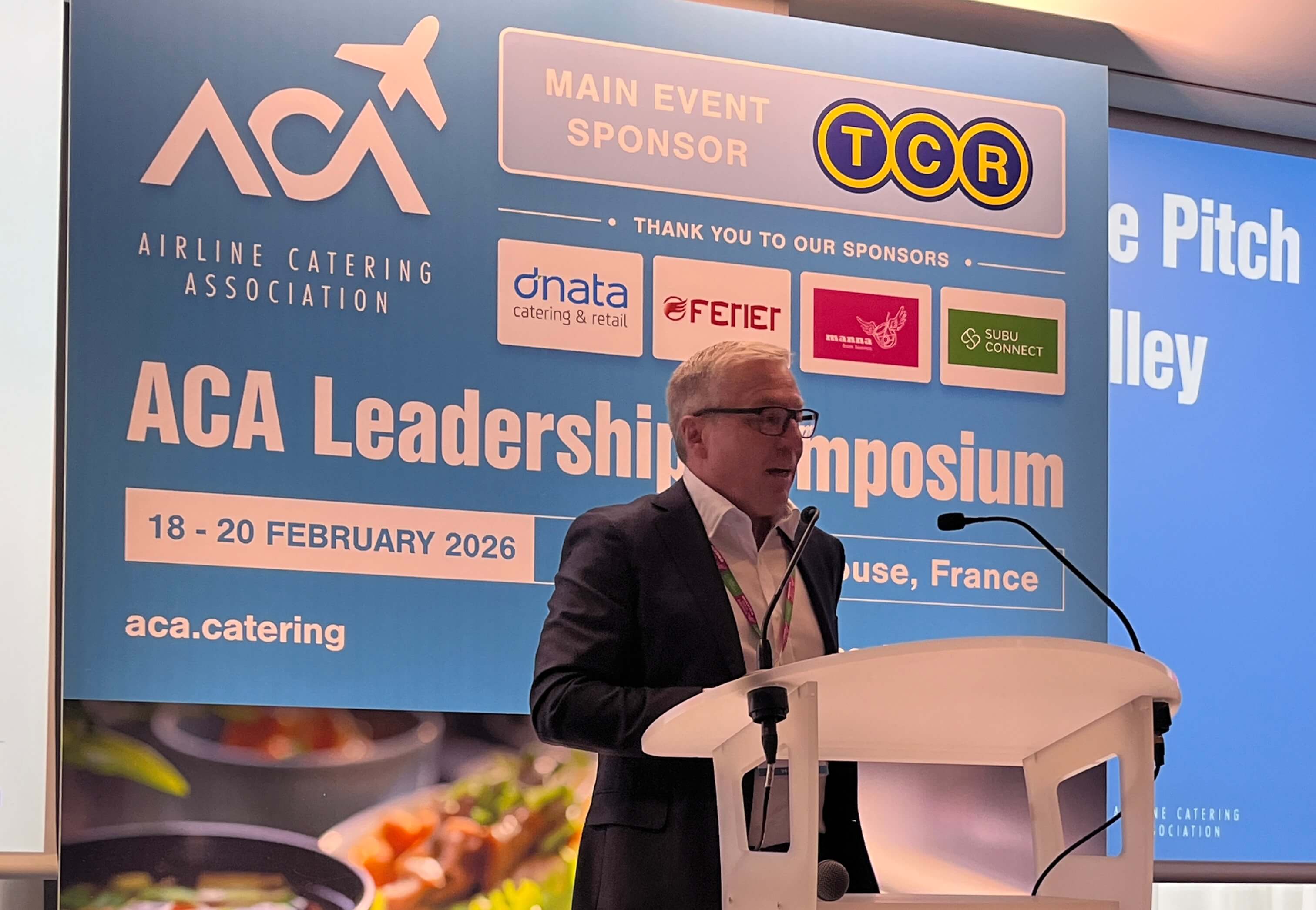
Managing Director Ashley Meddings introduces delegates to Manna from Heaven in the first presentation of the the Pitch Galley
The lineup underscored just how diverse — and increasingly technology-driven — the sector has become. Presenters included representatives from Manna from Heaven, PreGel, Funny Food Factory, Hello Straw, Jofrauto, TCR, Airport College International, Countifi, NEMIS, PlanTolt, C8Rtech, inflightFeed, SUBU Connect and YouMeal.
From sustainable materials and specialty ingredients to digital traceability, analytics and training, the Pitch Galley highlighted a clear theme: innovation across the value chain is accelerating. For caterers and airlines navigating margin pressure, operational complexity and rising passenger expectations, the format offered a concentrated snapshot of the tools and partners shaping the next phase of onboard service.
State of the industry address
After the networking lunch sponsored by Ferier, delegates reconvened to hear the state of the industry address from Airbus Senior Strategist for Cabin & Cargo Nicolas Jourdan.
Opening with a warm welcome to Toulouse, Jourdan set the tone by reminding the room why stepping back to examine the bigger picture matters. Aviation, he noted, often operates in short cycles — planning one month, one quarter or perhaps six months ahead. But understanding where the industry is heading over the next decade is equally critical. Long-term forecasting, he suggested, provides the strategic guardrails that help current operational decisions align with future realities.
Backed by a steady stream of data and global traffic statistics, Jourdan delivered a measured but optimistic outlook.
“Right now, it does not look too bad,” he said candidly, acknowledging that disruptions are inevitable in a sector as dynamic and exposed as aviation. Yet the past several years have underscored something equally important: resilience. The industry has demonstrated not only its ability to withstand shocks, but to rebound quickly and at scale.
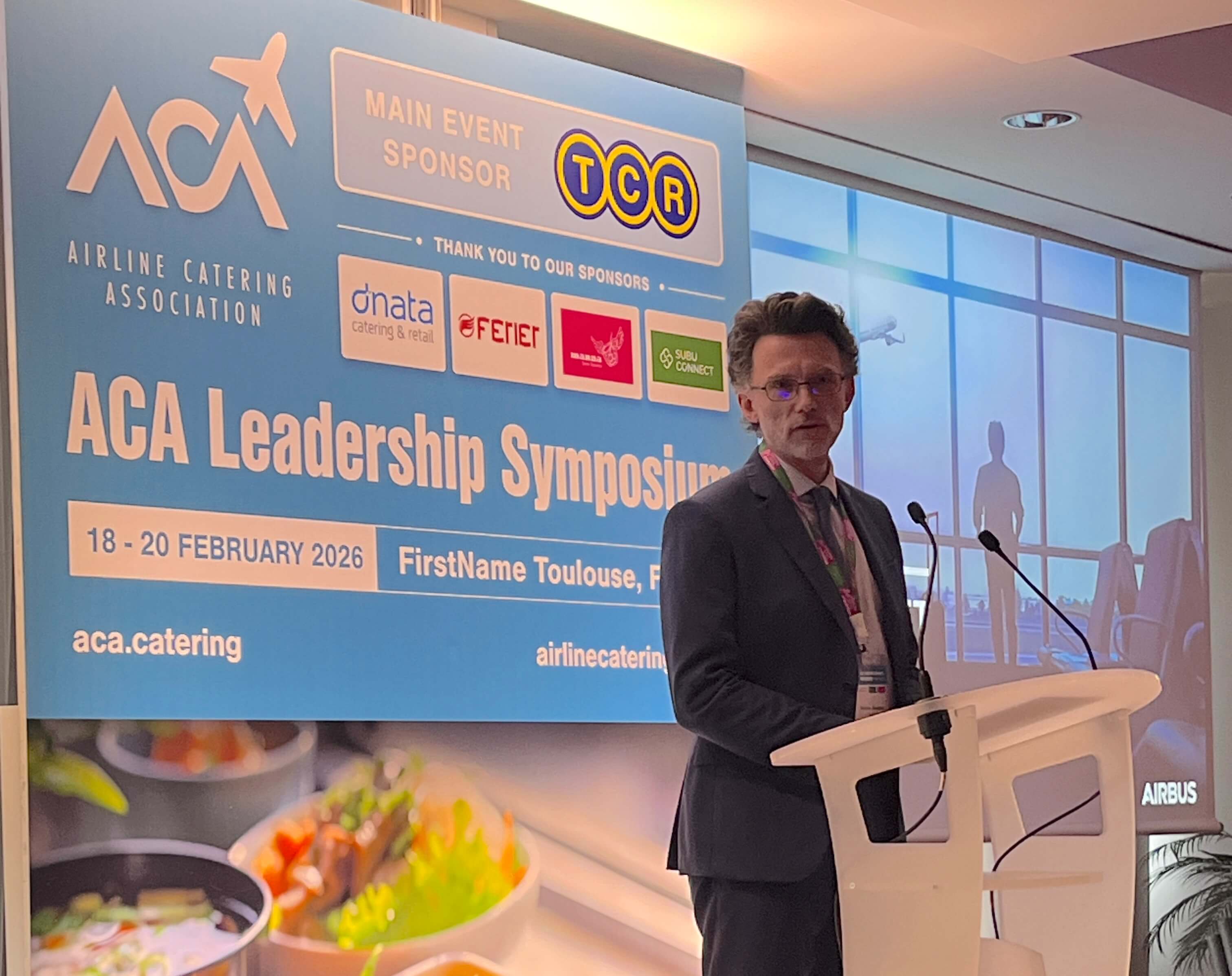
Airbus Senior Strategist for Cabin & Cargo Nicolas Jourdan delivers state of the industry address
Indeed, 2024 marked a symbolic milestone — the first full year in which global passenger volumes exceeded 2019 levels, officially classifying it as the recovery threshold. That milestone, Jourdan explained, signals more than a simple return to pre-pandemic norms; it marks the beginning of a new growth cycle.
Looking ahead, the trajectory remains positive. There is, he said, a building willingness — and in many markets, a growing necessity — to fly. Demand fundamentals remain strong, supported by expanding middle classes, sustained appetite for travel and the continued globalization of business and leisure.
At the same time, the data from 2025 points to a subtle but important shift: the industry has moved from rebound to stabilization. The explosive surge of pent-up demand is giving way to more predictable, structurally supported growth. For airlines, suppliers and cabin and cargo stakeholders alike, that transition signals a move from recovery mode to strategic recalibration — investing not just to catch up, but to compete in the decade ahead.
In short, the message from Toulouse was clear: the future of aviation is not only intact, but also entering a more mature and strategically significant phase.
Panel discussions paint a clear picture
The afternoon program shifted the focus squarely onto airline and catering leadership, beginning with a panel moderated by PAX’s Jane Hobson, entitled “The Airlines’ Perspective: What’s up for 2026 and beyond?”
The session brought together Air France VP In-Flight Services & Supply Chain Rosine Allené; LOT Polish Airlines Deputy Director Product Development & Customer Experience Agnieszka Bargieł; and Air India DVP Inflight Services & Experience Shashank Bhardwaj.
Framed around evolving passenger expectations, sustainability and innovation in onboard service, the discussion underscored how airlines are recalibrating inflight dining for a more personalized, operationally efficient and environmentally conscious future.
Across markets and business models, panelists agreed that passenger expectations continue to rise — not only in terms of taste and presentation, but also transparency, flexibility and responsible sourcing. Personalization is becoming less of a differentiator and more of a baseline expectation, with digital tools, data (and social media) playing an increasingly central role. At the same time, sustainability is no longer a parallel initiative; it is embedded into menu development, supply chain decisions and waste management strategies.
For the catering delegates in the room, a key takeaway was collaboration. Airlines emphasized the importance of working more closely with catering partners to align on measurable sustainability targets, reduce over-catering and innovate in ways that enhance both the passenger experience and cost control.
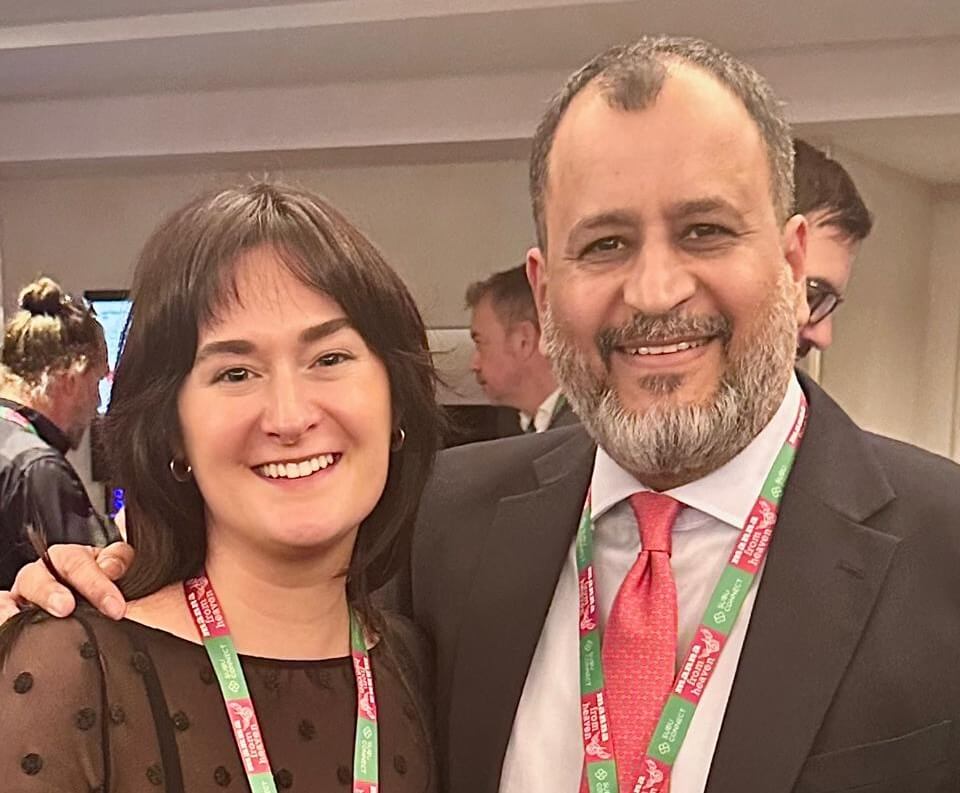
PAX Managing Editor Jane Hobson and Air India DVP Inflight Services & Experience Shashank Bhardwaj after the panel “The Airlines’ Perspective: What’s up for 2026 and beyond?”
The second panel, “A new era of airline cuisine: leadership insights from the top,” elevated the conversation to CEO level. Moderated by Gamba, the session convened senior executives from Newrest, gategroup, dnata and KLM Catering Services to examine growth opportunities and industry collaboration from a strategic perspective.
Opening the discussion, Gamba asked panelists to identify the single most significant shift in inflight dining expectations over the past decade—in one succinct sentence. The responses converged around several themes: personalization at scale, digitalization across the value chain, the growing influence of big data and the accelerating importance of sustainability and culinary innovation.
On the topic of social media, Newrest’s Stent-Torriani acknowledged its dual impact. While online platforms can amplify negative experiences, it also offers airlines direct, unfiltered feedback from passengers.
“Our own misconceptions can sometimes be corrected by insights from social media,” he said. “There is actual knowledge—and we can use those trends to deliver better and smarter for our passengers.”
Technology’s role in reducing waste and improving efficiency also featured prominently. Discussing measurement and data integration, gategroup CEO Christoph Schmitz emphasized the importance of quantification in driving progress.
“What you do not measure, you do not manage,” he said, noting that with the gradual integration of AI and advanced analytics, gategroup is gaining clearer visibility into operational performance — a development that ultimately supports greater efficiency and reduced unit costs.
Does bigger mean better?
The panels concluded with a candid and operationally focused discussion titled “Supply chain and kitchens: Does size matter?”
Moderated by Anne-Laure Perrin, dnata’s Global Head of Operations and ACA Chairman of the Board at dnata, the panel brought together Daniel Robinson, CEO of Niche & Bespoke; Matshela Seshibe, CEO of Air Chefs; Allison Budd, CEO of Air Fayre; and Joana Morgado González Dias Vilela da Silva, CEO of Cateringpor.
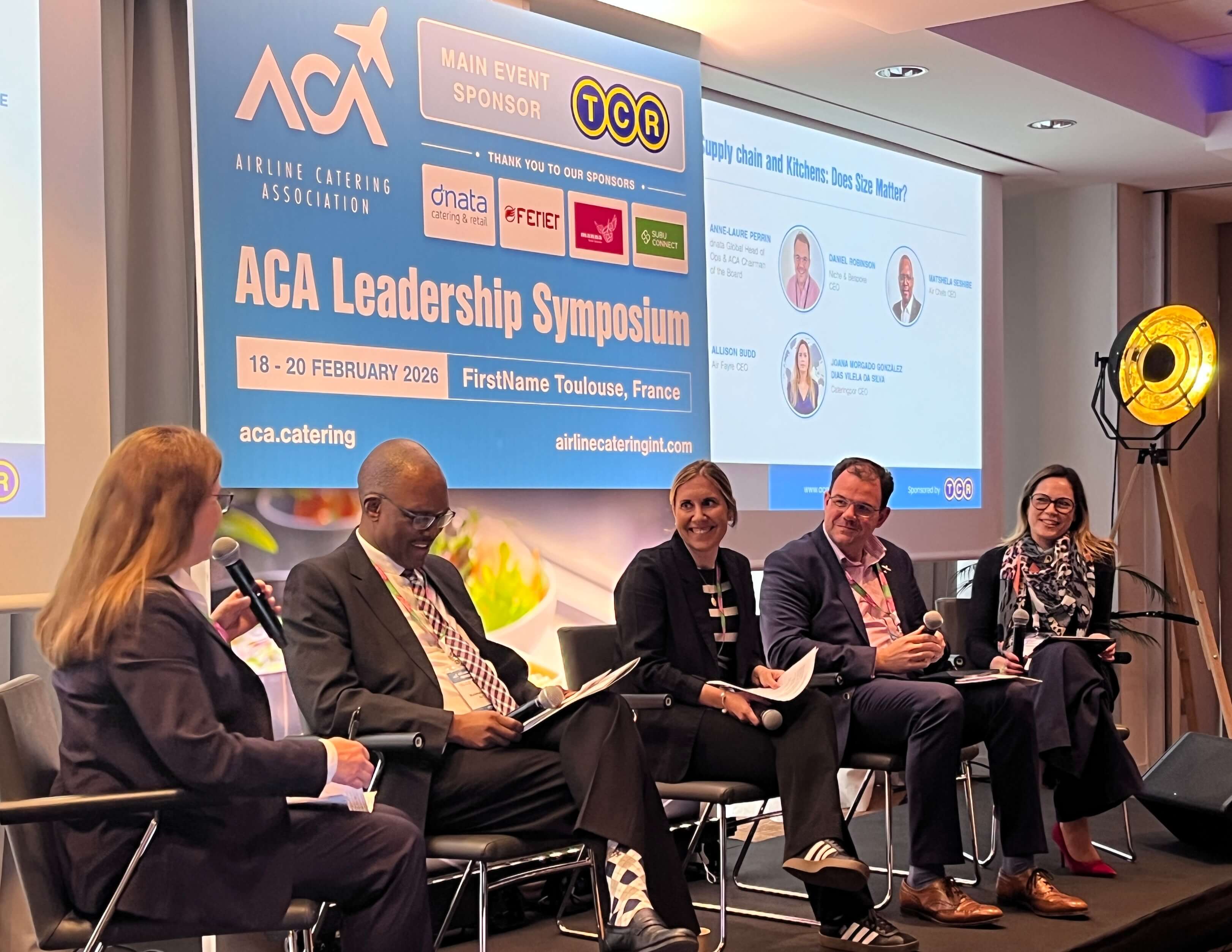
Panelists on stage for the “Supply chain and kitchens: Does size matter?” panel
Along with some tongue-in-cheek humor, the central question was whether scale is the ultimate advantage in a volatile environment. For da Silva, the answer was nuanced.
“Bigger is not necessarily better,” she said. “The challenge is to find the right balance between the scale and the agility to adapt.”
Her point resonated across the panel: while larger organizations may benefit from power and built-in resilience, size alone does not guarantee responsiveness. In an environment where menus shift quickly, sustainability targets tighten and operational disruptions can arise with little warning, adaptability has become a critical currency, Robinson echoed.
The discussion ultimately suggested that the future of airline catering may not hinge on scale alone, but on how effectively companies — large and small — leverage incoming data and to balance efficiency with flexibility. In a supply chain still recalibrating after years of disruption, that equilibrium may prove to be the industry’s most valuable asset.
Taken together, the afternoon panels painted a clear picture: the next phase of airline cuisine will be defined not just by what is served onboard, but by how intelligently, sustainably and collaboratively it is delivered.
Conclusion and leadership transition
Following the final panel, Newrest’s Stent-Torriani returned to the stage to close out the day on a reflective note.
“It was great to see old friends and to make new friends. What an enjoyable day we had in all aspects. We welcome your feedback,” he said, thanking delegates for their engagement throughout the Symposium.
He then formally announced a leadership transition within the association, introducing Christoph Schmitz, CEO of gategroup, as the association’s new President.
The moment also marked a significant change for the organization. Stent-Torriani shared that Managing Director Gamba will be stepping down from his role.
“In sad news, after effectively building ACA from scratch in 2018, Fabio has decided to move on,” he said. “We are so proud that you spent this time with us. Thank you for all that you have done.”
In a tribute, the association presented Gamba with a cooking apron on behalf of the association — a fitting gesture in a room filled with industry culinary leaders.
Taking the stage for his final remarks, Gamba reflected on the association’s growth and achievements, noting its expansion to 22 members and its strengthened position within the inflight catering ecosystem.
“The association is in good hands with Christoph and gategroup at the helm,” he said. “In this transitional year, it is good to have a founding member at the helm—good luck to you Christoph, and your team.”
While Gamba’s successor has not yet been announced, the ACA board is currently reviewing candidates. He indicated he will likely be present in Hamburg for further farewells and to introduce the incoming Managing Director.
“ACA will continue to grow and become even more legitimate,” Gamba concluded. “It is time to give the association new blood after eight years. I am leaving a good legacy; the association is thriving and I will watch from a distance, so thank you all.”
With a new President in place and a leadership transition underway, the day closed not only on forward-looking industry dialogue, but on a clear signal of continuity and evolution for the association itself.
