
AFRA highlights industry challenges and progress in emissions reduction and sustainability
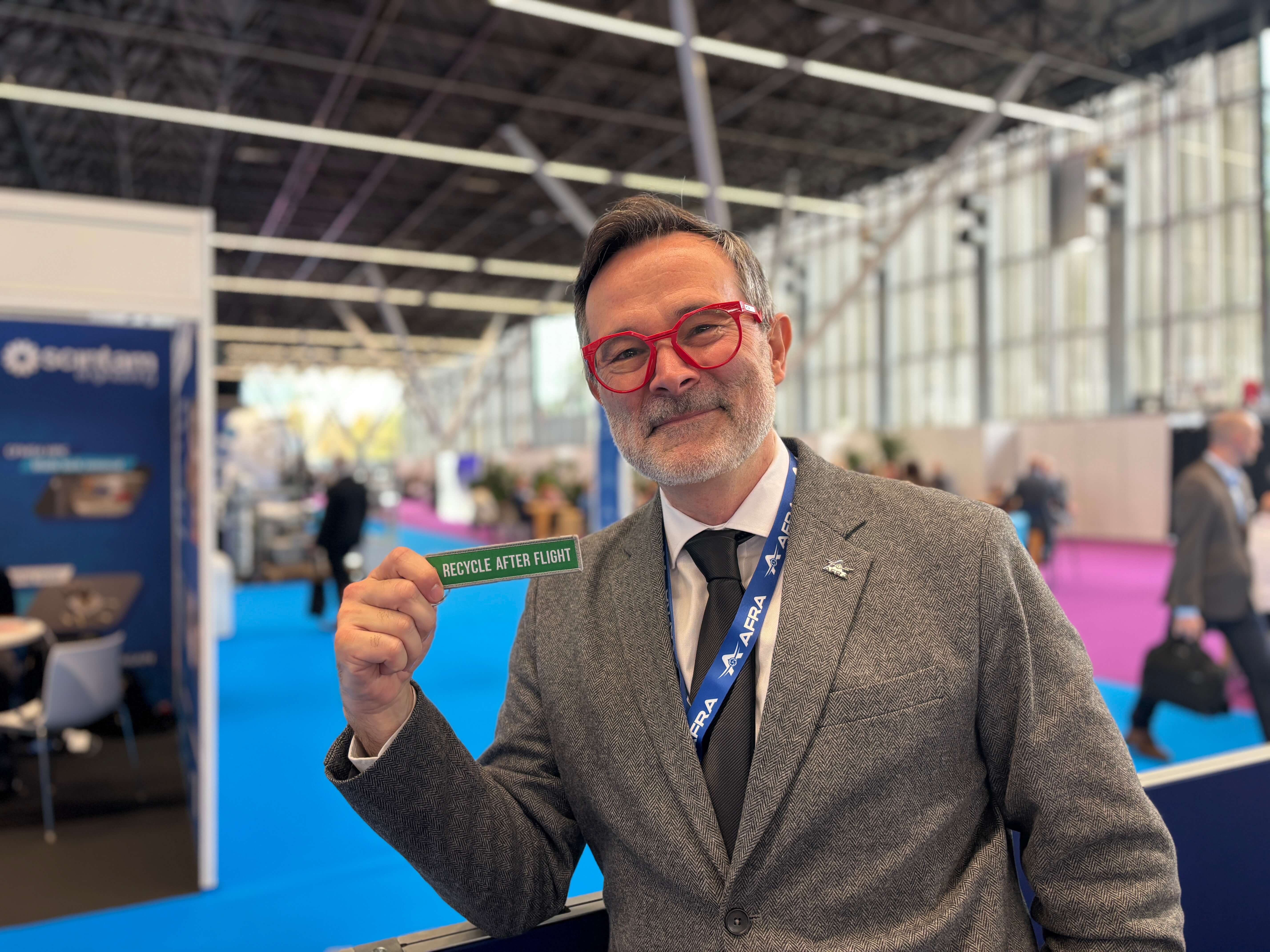
Lionel G. Roques, Executive Director of the Aircraft Fleet Recycling Association at Aviation Week's MRO Europe 2026 in Amsterdam, The Netherlands
At MRO Europe 2026 in Amsterdam, The Netherlands, PAX Tech sat down with Lionel G. Roques, Executive Director of the Aircraft Fleet Recycling Association (AFRA), to discuss the opportunities such events provide for AFRA and learn about the challenges and progress in reducing the environmental impact of aircraft.
AFRA is a nonprofit association that is dedicated to advancing responsible aircraft disassembly through its accreditation program and brings together members and accredited companies worldwide. AFRA membership connects members with industry leaders, fosters collaboration on best practices and supports members’ role in shaping the future of aircraft recycling and materials management.
Roques told PAX Tech in October that MRO Europe and MRO Americas provide important opportunities for AFRA to connect with industry members, share insights on end-of-life aircraft management and understand evolving market needs. Alongside its commercial focus, the organization aims to highlight the aviation industry’s potential to advance sustainability and the circular economy through the traceability, reuse and proper recycling of aircraft components and materials.
“Not a lot of industries are as good as the aviation industry when it comes to traceability and reuse of old parts,” says Roques. “We excel at identifying the parts with potential to continue their use properly and ensuring proper recyclability.”
This message of sustainability, reusability and end-of-life best practices are what AFRA aims to support and convey through its initiatives, Roques explains.
A major milestone in China
The AFRA Accreditation Program is the only industry-developed standard for aircraft disassembly and materials recycling, based on the AFRA Best Management Practices Guide. Organizations with this accreditation demonstrate a commitment to safety, quality and sustainability while supporting environmentally responsible practices across the aviation industry.
AFRA aims to promote best management practices for aircraft disassembly, parts reuse and recycling through its voluntary accreditation program. Roques highlights a major milestone for the organization that came in September, when the Civil Aviation Administration of China (CAAC) formally recognized AFRA Disassembly Accreditation within its regulatory framework, establishing a new pathway for qualifying overseas organisations seeking to supply recovered aircraft components to the Chinese aviation market.
“This is a significant milestone for AFRA and our accredited members,” said Roques. “After three years of close collaboration with the Chinese authorities, having AFRA accreditation formally recognized is a major achievement. It creates new opportunities for qualifying organizations seeking access to the Chinese market and demonstrates the growing importance of recognized industry standards, independent accreditation and robust traceability. It also acknowledges the work AFRA and its members have undertaken over the past 20 years to advance safe, responsible and sustainable aircraft end-of-service practices.”
A look at the lifecycle
As far as the product lifecycle in aviation, Roques notes that the challenges differ inside and outside of the aircraft, but he outlines three major areas for lifecycle impact: The fuselage, the cabin and the engine.
He points out that aircraft engines generally have a much longer lifespan than the aircraft itself, thanks to independent maintenance, overhaul and resale cycles. However, cabin interiors present a unique end-of-life challenge given that they are often replaced multiple times during an aircraft’s service life due to branding and passenger expectations. And, the interior parts are difficult to recycle because of their complex mix of composite materials, foams and fabrics.
Roques emphasizes that there is not one uniform lifecycle for an aircraft. Its major components have different service lives, replacement cycles and end-of-life challenges, making cabin interiors particularly difficult to manage sustainably.
How airlines take action
Aircraft generate emissions at three stages of life: manufacturing, operations and end-of-life. While aircraft manufacturers work to minimize emissions during production, the majority of an aircraft’s environmental footprint comes during its operational life, which typically spans around 20 years, Roques explains. For that reason, efforts to reduce emissions throughout its service life offer the most significant environmental impact.
Using composite materials to reduce aircraft weight is one way to significantly lower emissions throughout an aircraft’s two-decades long operational life. But, Roques says this creates an end-of-life trade-off, because materials such as carbon fiber can be difficult to recycle. This ultimately raises questions about balancing operational efficiency with long-term sustainability.
But Roques cautions against losing sight of the bigger picture, arguing that the emissions savings achieved through aircraft weight reduction during 20 years of operation should not be overlooked because of end-of-life recycling challenges.
“What the airline can do when retiring the aircraft is ensure that everything valuable continues flying,” Roques explains. “This means recovering some parts for reuse, reducing their impact and ensuring that when it is dismantled and recycled, it is done properly.”
He also points out that more than 65 to 70 percent of aircraft are owned by leasing companies, rather than the airline, but airlines retain a responsibility for an aircraft’s environmental impact even when returning it to a lessor at the end of a lease. He argues that their sustainability commitments should extend beyond aircraft selection and efficient operations to ensuring that end-of-life materials and components are properly managed, reused or recycled.
“Airlines have a significant influence on that,” he affirms.
The passenger perspective
Passengers generally have limited awareness of what happens to aircraft at the end of its service life, with their understanding of sustainability shaped by more visible issues like cabin materials or flight emissions labels on the airline’s website. Roques notes that airlines rarely communicate efforts around aircraft reuse, dismantling and recycling to the traveler.
But, he cites Lufthansa as an example of how carriers can raise passenger awareness of sustainability through clear communication. Through its Upcycling Collection campaign, the airline is showcasing how it dismantles and reuses the component parts of retired aircraft. The airline’s WorldShop features cabin materials turned into second-life products such as cross-body bags and cufflinks, helping passengers see the tangible benefits of aircraft recycling.
Roques says that bringing recycled aircraft materials back into the cabin in visible ways, such as using recovered plastics in meal trays, can demonstrate a tangible, closed-loop approach and help passengers connect with the carrier’s sustainability initiatives. Encouraging passengers to take amenity kits with them after travel for continued usage rather than creating single-use waste is another way that airlines and passengers together can reduce the environmental impact of air travel.
A work in progress
While aviation frequently faces criticism over its emissions, the industry’s strong track record in component reuse and maintenance is often overlooked. Roques emphasizes that aviation has well-established processes for ensuring reused parts meet strict safety standards, making reuse an important but underrecognized part of its sustainability efforts.
“Just because you do not see it, does not mean it is not happening,” Roques says of the industry’s progress. While he acknowledges sustainability and emissions have become trending topics post-pandemic, he says that aircraft recycling and sustainability started more than 20 years ago. “It is not a fancy, new subject. It is something that was worked on in the background for a very long time.”
He adds that everyone, from the airline to the passenger, has a role to play in improving sustainability and recycling.
For Roques, the aviation industry must acknowledge its environmental responsibilities without being defined by its environmental impact. While reducing emissions and managing waste are essential, he emphasizes the need to recognize the industry's positive role in connecting people and fostering relationships, while raising awareness of the work being done to make air travel more sustainable.
