
En Route International’s Nick Wiley on facing key industry challenges
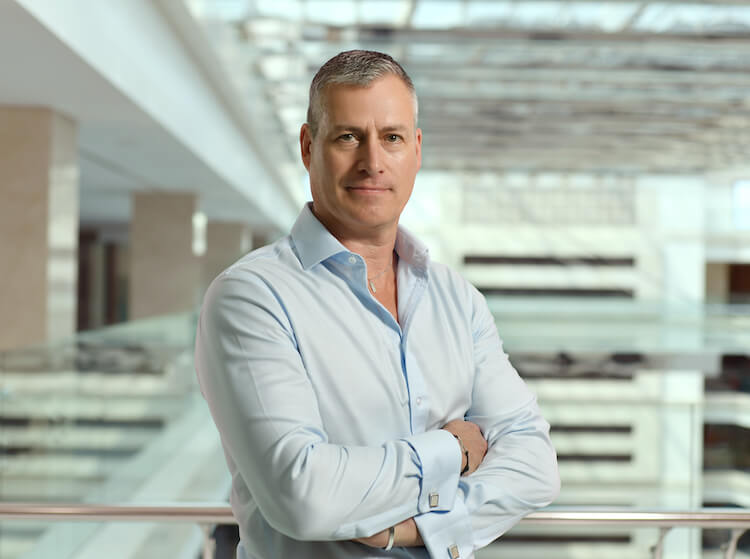
Nick Wiley, En Route’s Global Managing Director
In advance of WTCE 2023, En Route International wanted to get a clear understanding of the challenges facing the airline catering industry today. As a result of this, The Embracing Challenges and Harnessing Trends in Airline Onboard Hospitality report was released in June. In the report, ten industry stakeholders assisted En Route International’s research team to produce insights about sustainability trends, technological innovations, and what passengers are really looking for inflight.
Key insights from the report include “a growing importance placed on the use of perceived high-quality ingredients,” a rising popularity of “uncomplicated, yet satisfying snacks” and “a stronger emphasis on supporting local businesses and sourcing products from nearby regions.” In terms of technology, optimizing digital touch points (from booking a flight to pre-ordering food items) remains the top priority for investments.
The report came out at a time where, in the wake of the COVID-19 pandemic, everyone’s goal was “just to get things working,” Nick Wiley, En Route’s Global Managing Director, tells PAX International in an exclusive interview. Facing every challenge head-on — from labour shortages to supply chain issues — has been central to Wiley’s tenure with the company.
Wiley was brought in as En Route’s Global Managing Director in 2021 with over 25 years of leadership experience in food retail, food manufacturing, hospitality and transport & logistics. As a company, En Route International provides food products and supply chain solutions to airlines and other customers. With logistics hubs and offices in Australia, USA, UK, Europe, Middle East and China it is a truly global company that partners with many of the world’s largest airlines and airline catering organizations.
The rising importance of special meals
A key theme of the recent report is special meals. A prediction is made in the report that the topic will only increase in relevance in the upcoming years. “Millennials and Gen Z are the driving force,” the report says, “particularly for vegetarian and vegan meals.”
Talk of plant-based meals is nothing new. What is, Wiley tells PAX International, is that younger generations are “making a choice about meat for different reasons.” Part of this has to do with different value sets.
The report states that Gen Z “are interested in foods and drinks that offer health and wellness advantages” whereas “87 percent [of Millennials] say that taste is the most important consideration when they are choosing which products to buy.” Gen X “enjoy both comfort foods and familiar flavour profiles” while the Baby Boomers “tend to opt for traditional flavour preferences, such as beef, pork and seafood dishes.” The report details each generation's reported preferences in terms of how much money they are willing to spend and what ingredients or qualities are important.
“We can only respond, in terms of product development, to insights about what our customers want to eat,” Wiley says. “What’s interesting to me, is that the profile of traveller is changing.” At the show, it was reported that Gen Z is the generation travelling most for leisure with income under $50,000.
Making sustainability matter
With a varied professional background that comprises publishing, retail and manufacturing, Wiley’s exposure to different industries and perspectives has given him an opportunity to take a wide range of learnings and apply them to the challenges faced within the aviation sector.
“When it comes to sustainability in the aviation sector, it’s important we don’t work in isolation,” he says. “We need to look at the broader supply chain and market environment before embarking on changes made in silo. Otherwise, there can be a real knock-on effect that can lead to several complications down the chain which inevitably causes unnecessary ripple effects.” Real and positive change, he says, needs to be “collaborative, not competitive.”
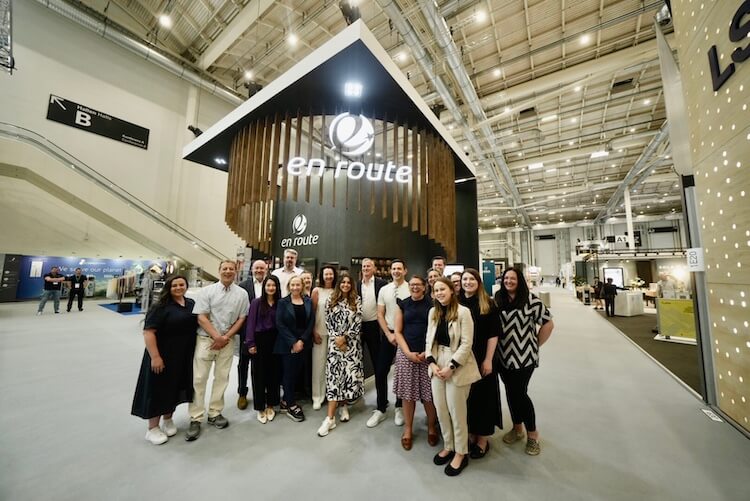
The En Route International team at their booth in Hamburg at WTCE 2023
Part of Wiley’s push to focus on collaboration comes into play in his role with the Aviation Sustainability Forum (The ASF). As a founding member, Wiley is eager to emphasize the importance of working together instead of racing each other toward the same goals—especially when it is the longevity of our planet that is at stake.
The En Route report echoes this sentiment, “Sustainability: It’s not just a buzzword,” one of the section headings reads. In discussions with stakeholders, the report states that: “there were concerns expressed that the urgency around replacing ‘non-sustainable’ materials can lead to knee-jerk decisions.” This might mean that an airline feels pressure to remove a number of individually plastic-wrapped headphones when a new paper-packaged product becomes available. To dispose of the plastic-wrapped product in a rush to have the outwardly more sustainable-appearing product in a traveller’s hand means that undue waste is created. The report suggests that “A considered approach to integrating recycling programs and encouraging the reuse of plastic items, such as inflight packaging or amenity kits, can help to further promote circularity.”
When it comes to En Route’s customers, Wiley says he always has to keep the regulatory aspect of managing waste in mind during conversations about sustainability. “Typically end of journey waste heads to landfill or incinerator at the moment,” he says. “The challenge for us as an industry is we need to be pushing for the result that we want in terms of the end-to-end result. Given this, the discussion about moving to recyclable or compostable materials becomes somewhat irrelevant and frankly starts to look a lot like greenwashing.”
This means certain questions must be addressed. “What do we want governments to do?” Wiley asks. “Do we want them to allow us to separate the waste and then recycle it?”
Amid regulatory discussions, suppliers have to help airlines meet the demands of passengers. Wiley says his team makes every effort to inform the customers about what is available (ie. A new, plastic-free board) as soon as possible. “We have to be proactive and tell customers what they can have,” he says. “And, also, what it’s going to cost.” Cellulose packaging materials (made from plants), for example, are more expensive than traditional plastic counterparts.
When it comes to plastic, Wiley has a point to make. “Plastic as a term is far too broad,” he says, explaining that “Everybody talks about plastic free, but actually, do you mean single-use plastic? Or do you mean just in general?”
He explains that cellulose can be used in a way that looks like plastic to travellers. Something he notes is important, especially when calling back to that “knee-jerk reaction” mentioned above, is passengers want to know why certain materials are being used. If a plastic-packaged headset is handed out when a paper-packaged version was advertised, it is important to bridge that gap of reasoning with a passenger.
This increase in transparency will minimize passenger confusion. “Trust and transparency are fast becoming prerequisites in consumer purchasing decisions,” the report says.
Wiley has ideas for ways to keep transparency open and forefronting a circular economy. In a previous role, he worked with a company that would recycle materials repeatedly until they wound up in the final stage of insulation material. “There are things you can do,” he says simply. But overall, he says: “We’ve got to push for that regulatory piece and really encourage governments to make decisions that we can then actively plan for. Think big, start small.”
To read the full report please visit: www.en-route.com/wtce2023.
