
Seating suppliers redefine sustainable design
This is a special feature from the June/July 2026 Seating & IFEC issue of PAX Tech, on page 12.

(From left) Bonaventura Vitolo, R&TD Project Coordinator, Geven; Frederic Rodriguez, Head of Sustainability, STELIA Aerospace; Dr. Warren Bowden, Head of Innovation and Sustainability, Muirhead
The aviation industry has often equated a “greener seat” to one that is simply lighter weight. But as passengers demand sustainability they can see, airlines are progressively understanding the importance of an eco-friendly brand identity. In response, seating suppliers and material manufacturers are innovating to deliver products that offer greater longevity, better lifecycle assessments and sustainably sourced or upcycled materials.
As Bonaventura Vitolo, R&TD Project Coordinator at Geven tells PAX Tech, “Airlines’ current demand is to increase the seat’s recyclability rate close to 90 percent without compromising the weight-saving.”
But recyclability is not the only key aspect for the future of aviation. For Geven, “recyclability” must go hand in hand with “remanufacturing” of recycled materials to avoid downcycling and to use recycled products as primary materials for production.
In addition to improving the recyclability of seats, suppliers are focused on extending the lifecycle.
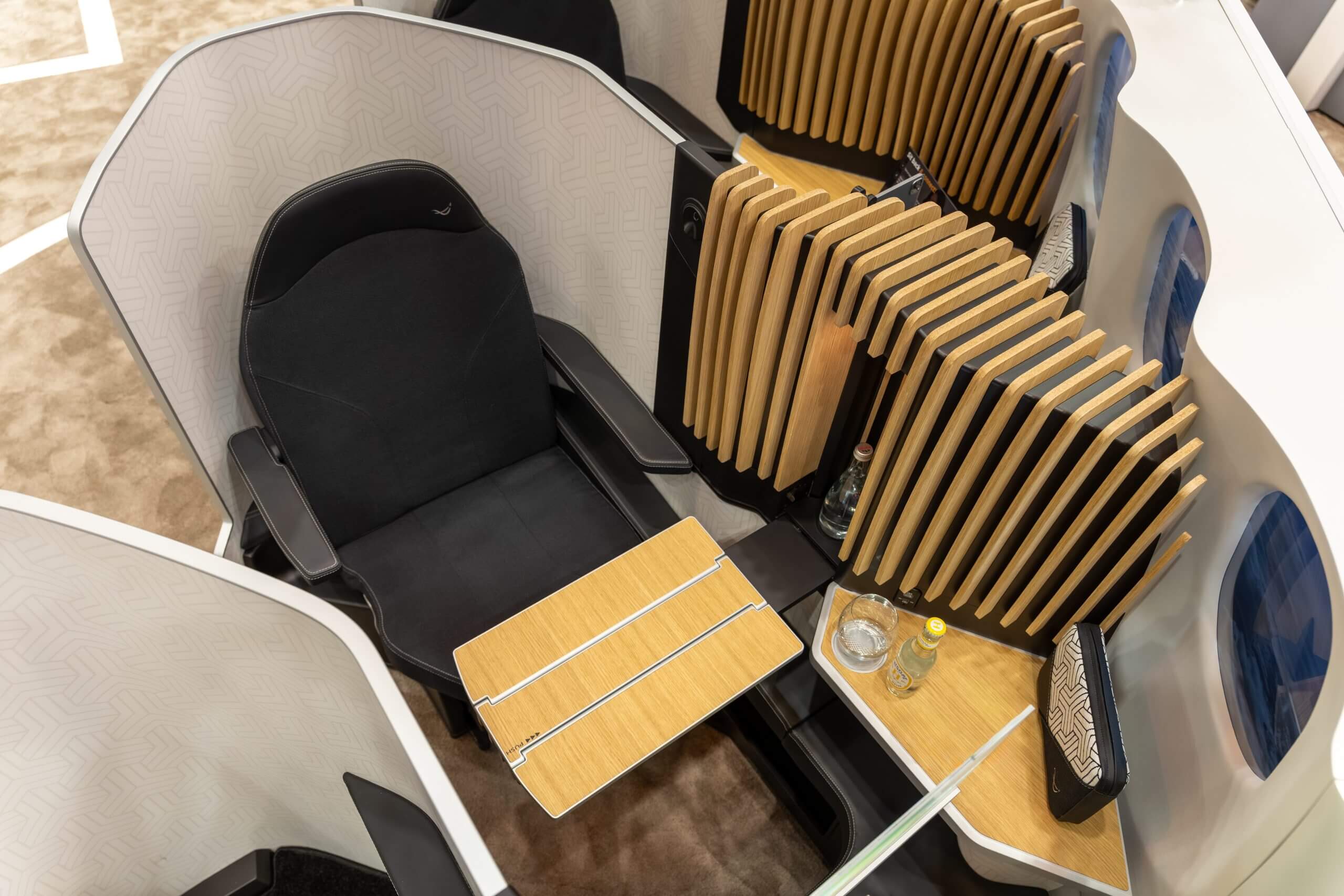
New version of OPERA® ESSENTIAL showcased at the 2026 edition of Aircraft Interiors Expo
Frederic Rodriguez, Head of Sustainability at STELIA Aerospace, explains, “We are shifting the industry conversation by going beyond mere weight reduction to optimize a seat's total lifecycle value through comprehensive Life Cycle Assessments (LCAs). By completely rethinking our seating architecture to reduce components, we maximize long-term reliability and extend product lifespans while preserving an uncompromised, premium passenger experience.”
He notes that a holistic approach minimizes the environmental footprint while delivering versatile operational benefits, be it reducing fuel burn, extending flight range or allowing extra cargo payload.
Dr. Warren Bowden, Head of Innovation and Sustainability at Muirhead, highlights the critical role of textile manufacturers in improving seating longevity and environmental impact. He says material durability, lifecycle performance, sourcing and processing must be considered.
“There is now greater scrutiny on what happens across the full lifecycle, including manufacturing impact and end-of-life outcomes,” he explains.
Reducing impact from the outset
Expanding the conversation beyond weight reduction requires suppliers to take these considerations into account from the start.
STELIA Aerospace’s Rodriguez tells PAX Tech that the company leverages three design principles: integrating eco-responsible materials, simplifying seat architecture and thoughtfully reducing electrical systems.
“This streamlined approach drastically enhances in-service reliability and repairability, significantly lowering the airline's Total Cost of Ownership (TCO). Guided by our ‘Built to Last, Designed to Care’ philosophy, we prove that modern sustainability does not look recycled; it delivers the uncompromised, world-class premium experience,” he says.
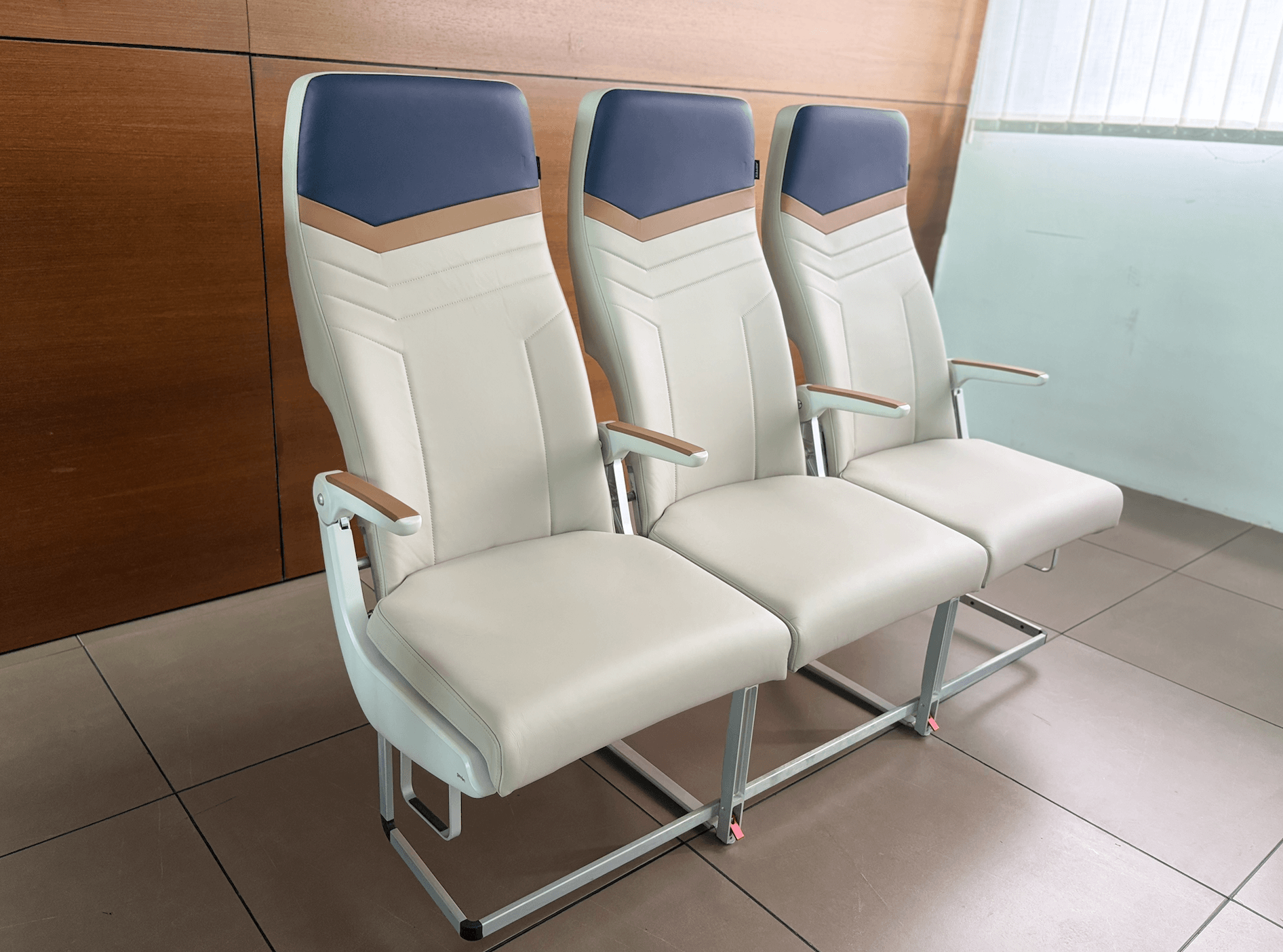
Geven’s lightweight Eva seat is specifically designed for high-density narrow-body aircraft
Geven’s Vitolo affirms that while weight reduction is the most important factor in reducing carbon dioxide emissions, it can no longer be the only parameter.
He explains that seat manufacturing has a significant impact on ozone depletion and freshwater eutrophication, reinforcing Geven’s focus on lightweight design, advanced materials and composite material reuse to reduce environmental impacts across the seat lifecycle.
Muirhead’s Bowden echoes the industry-wide recognition that material sourcing, manufacturing and product lifecycle matter.
“Sustainability within the cabin should not be defined by weight alone,” he explains. “This thinking shaped our development of BioPRO foam, which offers a new approach to polyurethane by replacing conventional fossil fuel-derived inputs with a protein derived from our own manufacturing process.
BioPRO reduces production-related carbon emissions by approximately 50 percent compared to conventional graphite-based foams while meeting aviation fire safety and performance requirements. Its molded manufacturing process eliminates material waste while the lightweight, protein-based structure provides flame resistance, enhanced durability, improved bonding and a soft, comfortable seating experience without the need for additional flame-retardant additives.
“Together, these characteristics shift the focus from weight alone to a broader view of sustainability, encompassing carbon impact, material efficiency, durability and passenger comfort,” Bowden says.
Sustainability at first sight
For airlines to actively promote sustainability in its brand story, passengers tend to favor cabin features they can see and feel.
Geven’s Vitolo says, “The use of bio-derived materials for non-structural parts, such as the literature pocket net or bumpers, can contribute to strengthening this awareness among passengers.”
Embedding sustainability into cabin materials from the outset enables more authentic branding, Muirhead’s Bowden explains.
“This includes designing for end of life, enabling materials to be separated and recovered where possible and ensuring that sustainability claims are supported by robust, verifiable data,” he says. “By combining thoughtful design with transparent, standardized data, airlines can build more meaningful narratives around sustainability that resonate with passengers and stand up to scrutiny.”
STELIA Aerospace’s Rodriguez reiterates this, saying, “This allows airlines to leverage STELIA Aerospace's expertise from the very inception of their cabin design across design, architecture, and material selection. This proactive partnership ultimately empowers airlines to perfectly align their unique brand identity with a superior passenger experience and highly visible environmental responsibility.”
Straight from the source
Looking ahead, Bowden tells PAX Tech that airline carbon reduction expectations are evolving in two clear directions: operational and embedded.
“There remains a strong focus on reducing emissions in operation through lightweight, fuel saving materials, but this is now being matched by a growing emphasis on the embedded carbon of materials, particularly the lifecycle impact of how they are manufactured.”
The result is increased demand for materials that can address both considerations simultaneously.
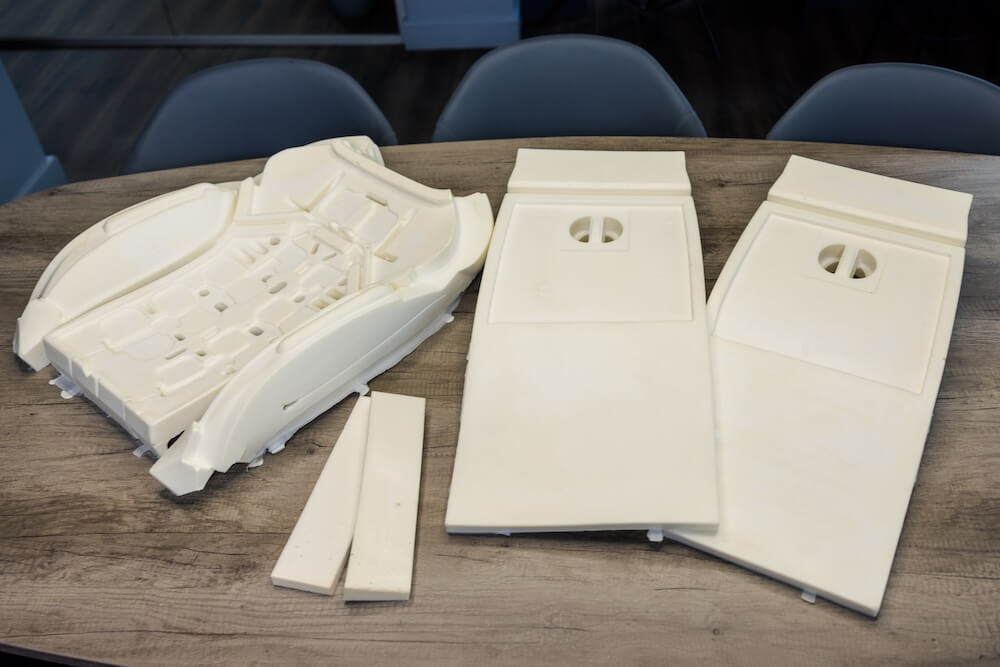
Muirhead’s BioPRO Foam bridges the gap between responsible material sourcing and performance expectations
“This dual focus reflects a broader shift in how sustainability is being evaluated by airlines in the cabin, moving from operational efficiency alone towards a more complete understanding of total environmental impact,” he says.
Muirhead’s BioPRO Foam bridges the gap between responsible material sourcing and performance expectations by combining responsible material sourcing with high-performance chemistry.
“The protein component is 100 percent bio-based, abundant and recoverable, offering a more responsible alternative to conventional inputs,” Bowden explains. “Its tri-amine bonding structure reduces the overall bill of materials required, resulting in a lighter weight but highly functional foam that outperforms, without additional ingredients.”
The result is a material that not only lowers carbon impact (equating to around 480 tonnes of CO2 avoided over a decade) but also outperforms conventional foams in comfort and durability. For Bowden, this reinforces the notion that more responsible sourcing does not require a compromise in performance.
“BioPRO demonstrates that sustainability cannot be measured through weight alone, but through total carbon impact over the full lifecycle and use of benign, natural components,” he says.
Non-negotiable comfort
For airlines trying to implement sustainable products onboard, the premium cabin may seem like an area of compromise. But STELIA Aerospace's OPERA® ESSENTIAL rewrites the story.
“OPERA® ESSENTIAL completely disrupts the myth that eco-design requires sacrificing comfort by maintaining our world-class Business Class standards with durable, recyclable materials,” says Rodriguez. “By smartly stripping away unnecessary complexity, we unlock extra passenger space while introducing an intuitive, patented, manual kinematic system that is faster, quieter and more reliable than traditional alternatives.”
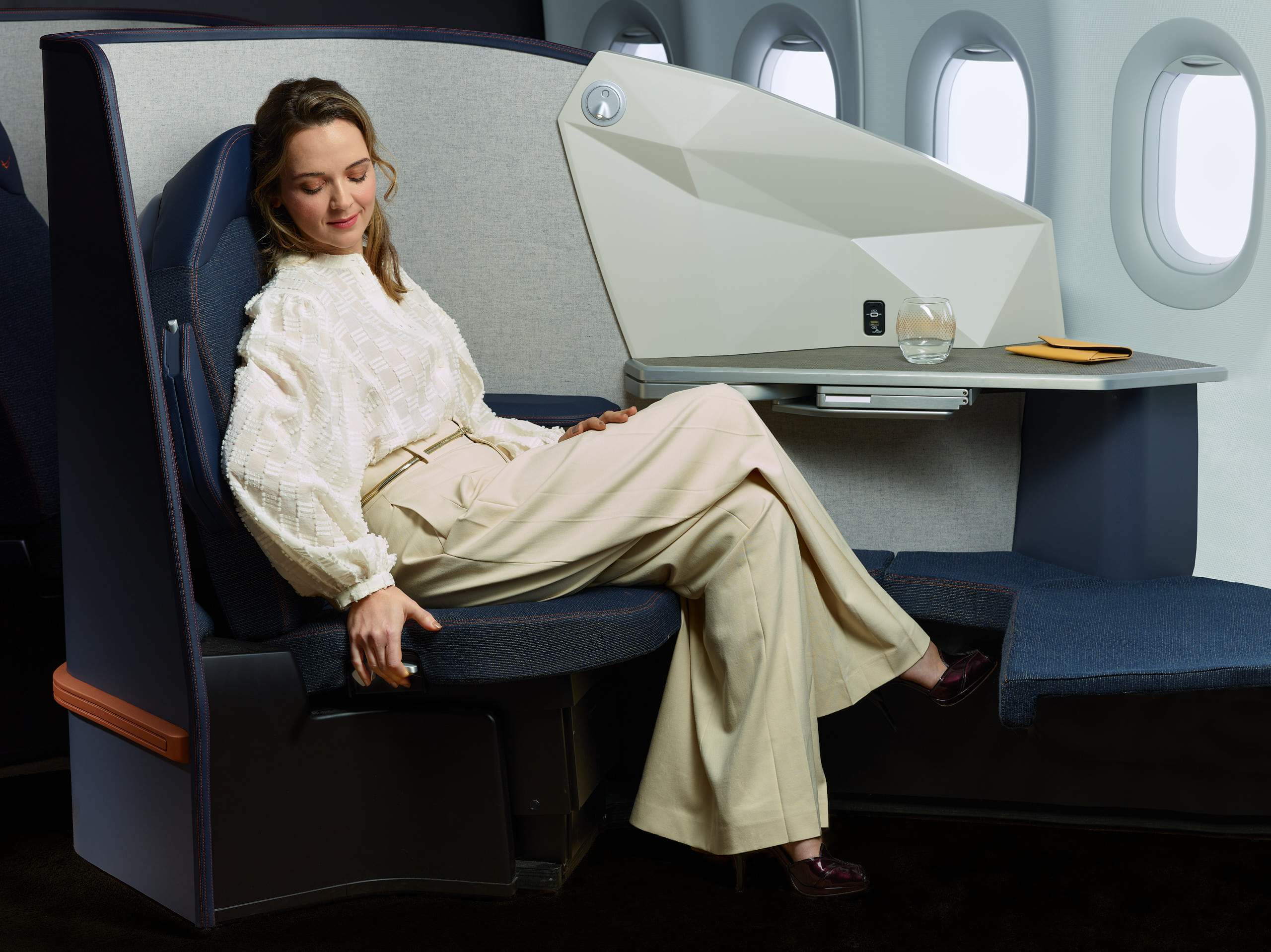
OPERA® ESSENTIAL featuring its patented, manual "Fast Kinetic principle" mechanism
The OPERA® ESSENTIAL Business Class seat underscores a holistic approach to sustainable seating by delivering a 30 percent weight reduction and a 32 percent lower environmental footprint compared to its elder OPERA® SA by addressing the product's entire lifecycle.
Rodriguez calls the seat, which was showcased in its latest iteration at AIX 2026 in April, a "triple win" because of its spacious premium experience, operational robustness with zero motor maintenance and significantly minimized carbon footprint.
The simplification of the seat also comes from limiting its reliance on non-essential electrical systems. In its design, STELIA Aerospace eliminated heavy electrical actuators and ECUs, reaching a 96 percent reduction in electronic components, in favor of its patented, manual “Fast Kinetic principle” mechanism, alongside a thermoplastic shell.
“This pioneering approach demonstrates how STELIA Aerospace continues to innovate by delivering a premium, low-impact Business Class passenger experience while maximizing reliability and reducing airline maintenance costs,” he explains.
Upcycle, lifecycle
Beyond sourcing, airlines are increasingly evaluating lifecycle impact of onboard products and seeking data to support procurement decisions.
STELIA Aerospace’s Rodriguez says, “Airlines have moved past surface-level green checkmarks and now demand hard, auditable LCA data to precisely track their environmental impact. Alongside this data-driven approach, there is a rapidly growing emphasis on long-term cabin operations, with reliability and ease of maintenance becoming paramount criteria. To withstand intensive operational use, airlines are actively seeking robust seating solutions that minimize ground downtime and guarantee flawless performance throughout the product's entire lifecycle.”
With heightened awareness of lifecycle impact comes emphasis on reusability and upcycling, a key component of Geven’s RECREATE project.
“Material sourcing toward reusability becomes of fundamental importance to reduce indirect carbon emissions linked to material supply,” Vitolo explains. “The main objective of the RECREATE project was to develop a set of innovative technologies aimed at exploiting the potential of End-of-Life (EoL) complex composite waste as a feedstock for profitable reuse of parts and materials in the manufacturing industry and aeronautical as well.”
.jpg)
Bonaventura Vitolo, R&TD Project Coordinator (left) and Fabiana Ferraro, Marketing and Communication Manager, Geven, showcasing RECREATE at AIX 2026
In the RECREATE project, Geven demonstrates the reuse of carbon fiber composites in aircraft seating and reprocessing of glass fibers for sidewall panels, showing sustainable end-of-life pathways for aircraft interiors. The project achieves up to a 90 percent material recovery rate and 80 percent remanufacturing rate, diverting composite waste from landfill. It also demonstrates significant environmental gains, including reductions in manufacturing energy use of up to 80 percent for glass fiber and 95 percent for carbon fiber, supporting by lifecycle assessment and energy measurement data.
Transferring the results of RECREATE to the aviation industry, Vitolo forecasts a decrease of materials going to landfill of 44,100k Tons per year for glass fiber and 7.2k Tons per year carbon fiber by 2030.
Sustainable seating is no longer about reducing the weight per passenger but instead becoming a set of opportunities for airlines and suppliers to make more informed decisions at every step of the design process—from material sourcing and manufacturing to end-of-life upcycling—without compromising passenger comfort.
