
Less artificial, more intelligent: Weave's global technology network
This is a special feature from PAX Tech’s June 2023 AIX issue on page 16.

Linaker believes Weave Intelligence will be the largest global network of connected outstations in the world by the end of the year
Ian Linaker identified a costly problem shared by all airlines. One that others had, to date, found too big to tackle. With his experience in this industry, including restructuring and turning around Watermark — Linaker’s next step was to solve one of the industry’s big headaches: What happens to onboard products once they enter circulation? Until now, there has been no good way of tracking the millions of items flowing around the world.
“Airlines are very good at procuring product, but the understanding of the product lifecycle can often stop there, once it’s on the plane,” Ian Linaker, Founder of Weave Intelligence, tells PAX Tech. “There are so many products where it then becomes extremely difficult to know what you have, how many you have, how old they are, and importantly, where all the product is at any one time.”

Weave’s reading infrastructure is strategically positioned around the world in key places airlines care about, such as an airline’s cabin cleaner or laundry facility
“Airlines have huge, costly black holes where money is leaving the airline,” is what Linaker boils it down to. These black holes are points all across the airline network but “the airline doesn’t know where.”
Whereas some catering operations are able to scientifically manage everything from the cost of a piece of cheesecake to the grams of protein per dish, these standards do not regularly exist for other products. “All airlines see is how many items they inject into the operation per year,” Linaker says. Weave Intelligence solves this problem.
For example, for textiles, Weave uses RFID tracking technology to monitor the lifecycle of every textile product in circulation. Tags are sewn in at an airline’s manufacturer and are not visible to passengers. Weave has developed a global network of reading terminals at key operational locations — detecting these tags to provide critical inventory and lifecycle data to its customers, at a unitary level.
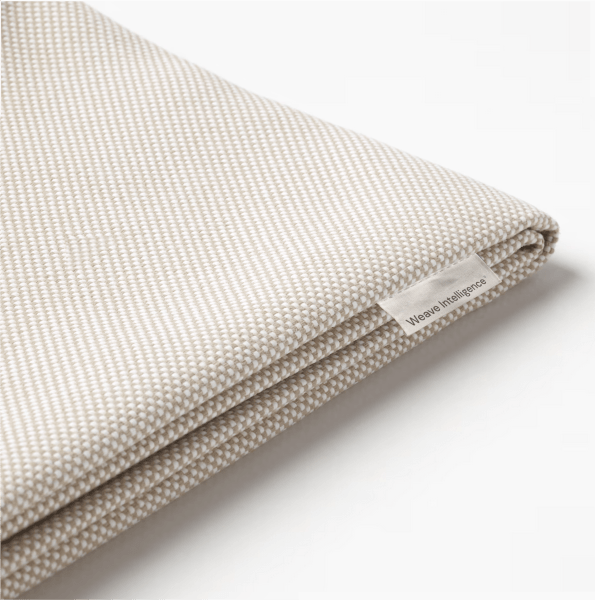
Weave’s tags are sewn in at an airline’s manufacturer and are not visible to passengers
Weave’s value, Linaker explains, is the complex software that pulls and then analyzes the real-time tag data from the outstations around the world. “Anybody can stitch in an RFID tag — that doesn’t really do anything significant. Weave has spent a considerable amount of time building a complex software along with an AI reporting platform that analyzes huge volumes of data and tells our customers what is happening to the products.” Weave delivers business intelligence that drives better operational decision-making.

Weave Intelligence uses RFID tracking technology to monitor the lifecycle of every textile product in circulation
Life of a product
Big airlines are international and have operations that touch every part of the world. “Because of that,” Linaker explains, “The supply chains are very fragmented.”
Independently managing hundreds of local cabin cleaner and laundry relationships can be difficult for airlines. Weave fills that gap.
For example, “Are there enough Business Class pillows in circulation? Where are they? Are we going to run out? Are they performing as expected?” Weave can answer all of these questions by tracking inventory automatically at a unit level.
“The moment you put Weave into a blanket, you can track everything from the number of blankets you’ve got on-hand, to a product’s age, its rotations, the overall equipment balance and location (as well as product) performance.”
“Weave can differentiate between all of the different SKUS because each tag is unique,” Linaker tells PAX Tech.
No data is read on the aircraft as the tags are passive — they are not battery powered. “That’s important,” Linaker says, “due to complex compliance requirements.”
Weave’s reading infrastructure is strategically positioned around the world in key places airlines care about — ones that are “typically a funnel or a bottleneck where they are taking product off an aeroplane and aggregating it, as well as reprovisioning aircraft” Linaker explains. Examples include an airline’s cabin cleaner, third-party warehouse, or at a laundry.
If a problem is identified — for example if a large quantity of product is consistently going missing from a particular location — an airline then has the power to investigate.
Sustainability improved
Weave ultimately improves the passenger experience by monitoring and increasing the quality of the products onboard. Weave also helps airlines deliver significant sustainability goals.
“If a customer knew that an item had been washed sustainably or had a zero-carbon impact, they would see that an airline is making an effort and is taking sustainability seriously — making conscious choices to try to do something about it in all aspects of the cabin,” he says.
Linaker knows that today, “doing more with less, and maximizing performance” is an important part of being environmentally conscious. When an airline sets out to place a blanket onboard that in theory should withstand 20 rotations, “they have no ability to know if they really are getting 20 rotations” and thereby maximizing performance.
Weave intelligence goes one step further in allowing airlines to track variables in a wash cycle to gauge the lifetime carbon footprint of each individual item. “Customers can then automatically report against this, and choose to offset the carbon impact by working with our various partners to plant trees,” and other carbon offset programs, Linaker says.
In addition to increasing the sustainability focus, airlines are using Weave to gain “a competitive advantage from the commercial benefit of improved procurement management.”
“With the ability to accurately manage their inventories, airlines can make better operational and procurement decisions, without being wasteful,” Linaker says. “Our clients are often quite surprised when they receive the first data set and we tell them what is actually occurring throughout their supply chains.”
Weave’s software, which provides its customers with a single source of real-time inventory data, then leverages this data to help its client solve the underlying issues. By the end of 2023, Linaker believes Weave will be the largest global network of connected outstations in the world.
