
RAVE Aerospace looks beyond traditional IFE with open platform technology
This is a special feature from the November 2026 APEX FTE EXPO issue of PAX Tech on page 32.
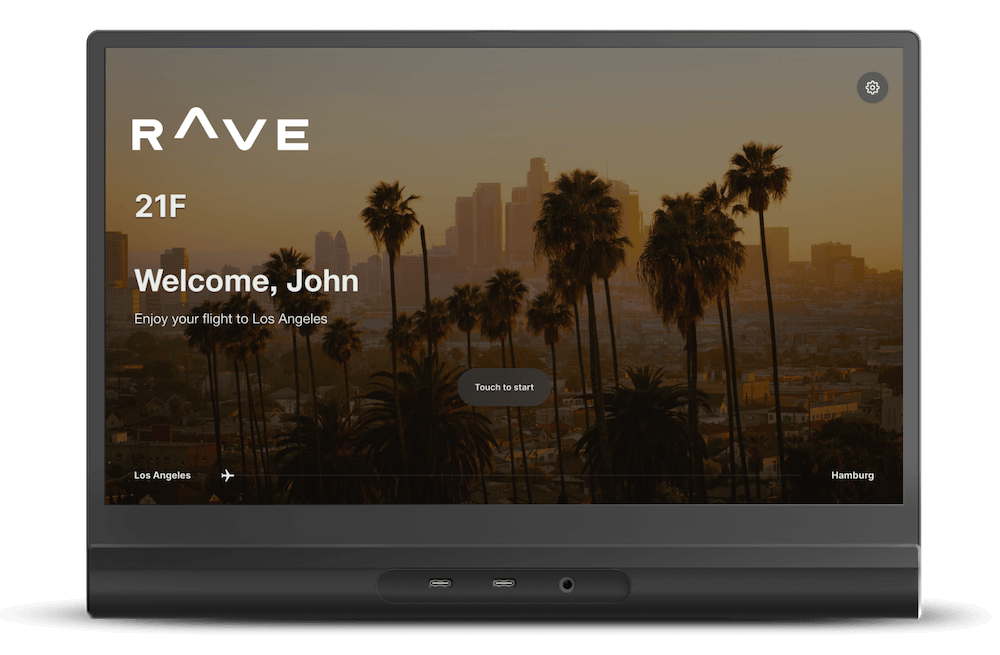
Open platforms could support personalized entertainment, onboard shopping, loyalty benefits, accessibility tools and real-time trip updates
It is no secret passengers expect their usual apps and entertainment inflight. Ben Asmar, Vice President, Strategy, Marketing and Corporate Development at RAVE Aerospace, tells PAX Tech, that traditional IFE systems are struggling to keep pace.
While the systems used to suffice delivering movies, TV and audio, today’s passengers move much quicker.
“Airlines need to evolve toward connected, personalized, service-rich digital experiences,” Asmar sums it up.

Ben Asmar, Vice President, Strategy, Marketing and Corporate Development, RAVE Aerospace
That means speeding up IFE refresh cycles and making it easier to introduce new apps, services, content models, accessibility and commerce options, as well as improving connectivity and incporating third-party services.
RAVE created the open platform system 4K RAVE Ultra IFE in response. Asmar says it has been “exceptionally well received” by passengers across airline customers, particularly due to its responsiveness and vibrant Ultra display.
But according to Asmar, the industry is only beginning to understand what is possible when the seatback becomes part of a broader connected digital platform. Open platforms could support personalized entertainment, onboard shopping, loyalty benefits, accessibility tools and real-time trip updates.
Long-term, Asmar says airlines could tailor experiences to passenger’s needs and journeys and test services on selected routes without waiting for a software release.
“The real opportunity is to move from IFE as a screen to IFE as a connected digital experience platform,” he explains.
Upgrading open platforms
To protect IFE investments, systems must evolve. Open platforms allow airlines to introduce new UI experiences through approved software, APIs, configuration tools and controlled-over-the-air-deployment-processes.
Airlines can update the platform and add new apps without replacing the underlying hardware.
Asmar says the key is having the right architecture: a modular operating environment, defined interfaces, controlled access to aircraft and passenger data, and a deployment model that respects aviation safety, security and reliability.
He suggests modular hardware and an open software platform help protect airlines’ long-term investment by supporting new uses without a complete system replacement. He points to RAVE OS 2, which will be backwards compatible with existing RAVE hardware at launch.
“That is where openness matters,” Asmar says.
Setting the standard
Standardized and open IFE platforms should be considered interdependent: The more open the ecosystem becomes, the more important it is to have strong platform standards.
“The goal is controlled openness: flexible enough to innovate, disciplined enough to operate at aviation scale,” he says.
The core operating environment, cybersecurity model, performance standards, data permissions, safety boundaries, certification-relevant functions and deployment controls must remain tightly governed by the platform.
“That is what protects the airline, the passenger and the aircraft environment,” Asmar explains.
The openness happens at the application and service layer, enabling airlines to integrate new experiences, external services and differentiate the passenger journey. Airlines can achieve this through defined APIs, approved tools and platform regulations.
Growing together
APIs enable third-party developers to integrate approved apps and services with the IFE platform in a controlled way, preserving the integrity of the onboard environment.
“Third-party developers are important because no single IFE company can or should build every future passenger experience itself,” Asmar says. “Airlines will want to work with content partners, retail and payments providers, loyalty platforms, destination services, advertising partners and emerging digital experience companies. An open ecosystem gives them a structured way to do that.”
The RAVE Developer Program is designed around that principle, with intent to provide developers and partners with the tools, documentation, APIs, Software Development Kits (SDKs), test environments and onboarding processes needed to design for the RAVE platform. It will also include the governance needed for aviation validation, security review, airline approval and controlled deployment, as well as offering partners a chance to promote projects on RAVE’s app marketplaces.
Open and accessible
Open platform systems also support improved accessibility.
While a closed system makes it challenging to introduce tools or respond quickly to emerging needs, an open platform provides a path for airlines to integrate specialized accessibility services, and improve them over time.
RAVE also makes its underlying accessibility features available through its SDK. Key features include intuitive navigation, high-contrast modes, screen-reader support, captioning, transcription, translation, simplified controls, personalization and support for passengers with visual, hearing or mobility needs.
“Accessibility is not just a feature category. It is part of the broader idea that the inflight experience should be more inclusive, more intelligent and more adaptable to each passenger,” Asmar says.
Evolving with the airline
As RAVE Aerospace heads to Singapore for APEX FTE EXPO, the company will focus on the future of an open, intelligent and connected passenger experience.
“We will be highlighting how RAVE is evolving beyond traditional IFE into a broader digital platform for airlines,” Asmar says. “The future of IFE is not just better hardware. It is a platform that keeps evolving with the airline.”
