
Thales curates cabin innovations of the future at Irvine facility
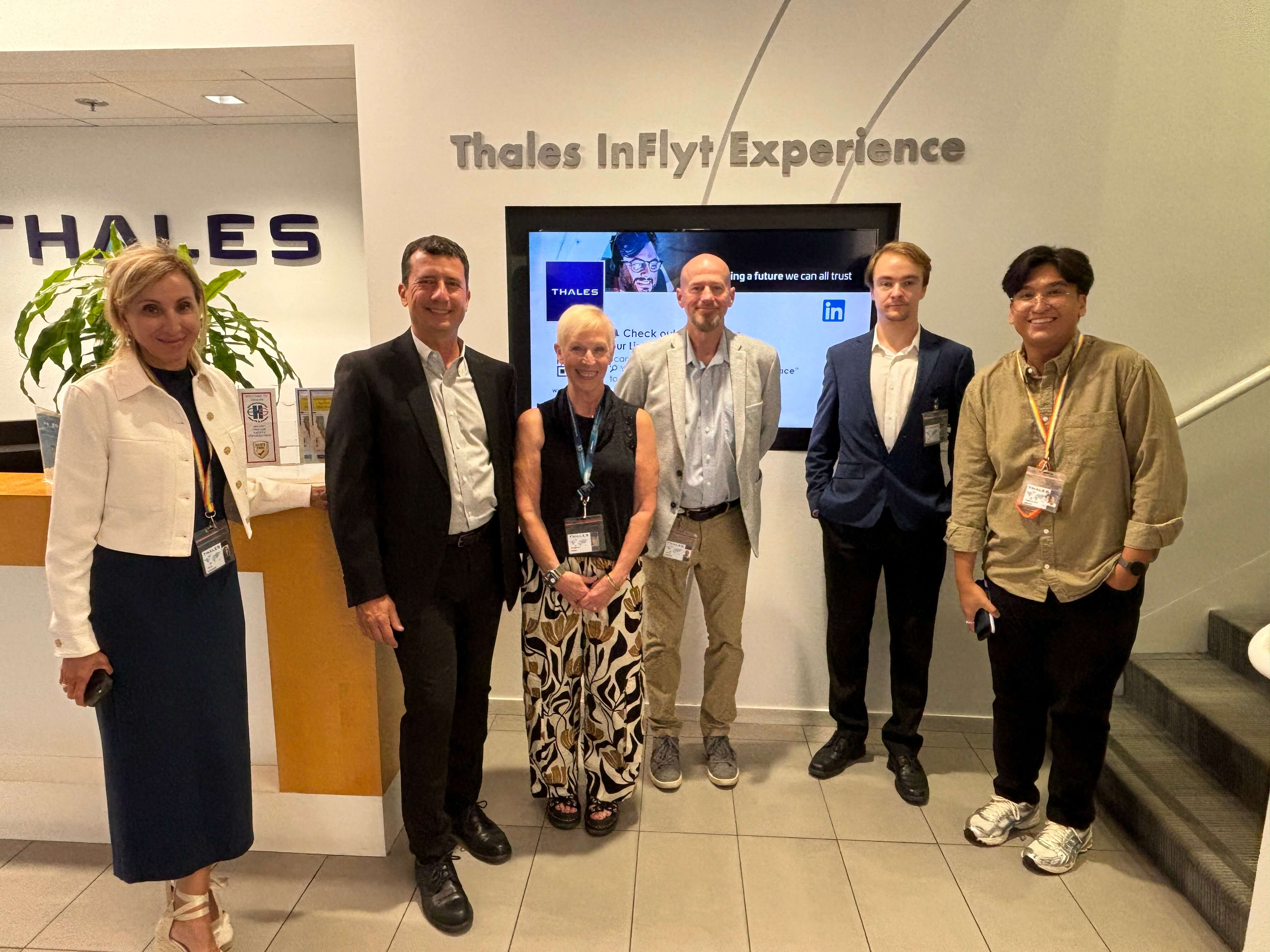
The Thales team at the Discovery Drive facility in Irvine, CA
A visit to the Thales InFlyt Experience facility on Discovery Drive in Irvine, CA, USA, makes it apparent that the possibilities for the future of the inflight experience are endless. This is a space where ideation and forward thinking are abundant, apparent and celebrated. The contagious enthusiasm upon arrival for how future technologies could reshape the passenger experience in the years to come is undeniable.
The site welcomes airlines to demo experiences and innovations that Thales is looking to further develop and, eventually, bring to market. As Margaret Stuart, Intellectual Property Director, Thales Avionics, tells PAX Tech, “We are showcasing new innovations and prototypes to airlines. And most importantly, we gather their feedback real-time to assess how these solutions can effectively address their pain points, aligning with the airlines’ vision for their passenger experience.”

Margaret Stuart, Intellectual Property Director, Thales Avionics
This mindset has informed the work being done at Thales InFlyt Experience, which features five different areas of focus: Accessibility, Smart Cabin Platform, VR Partnerships, Business Class Technology Demonstrator and Cabin Journey.
Innovating for accessibility
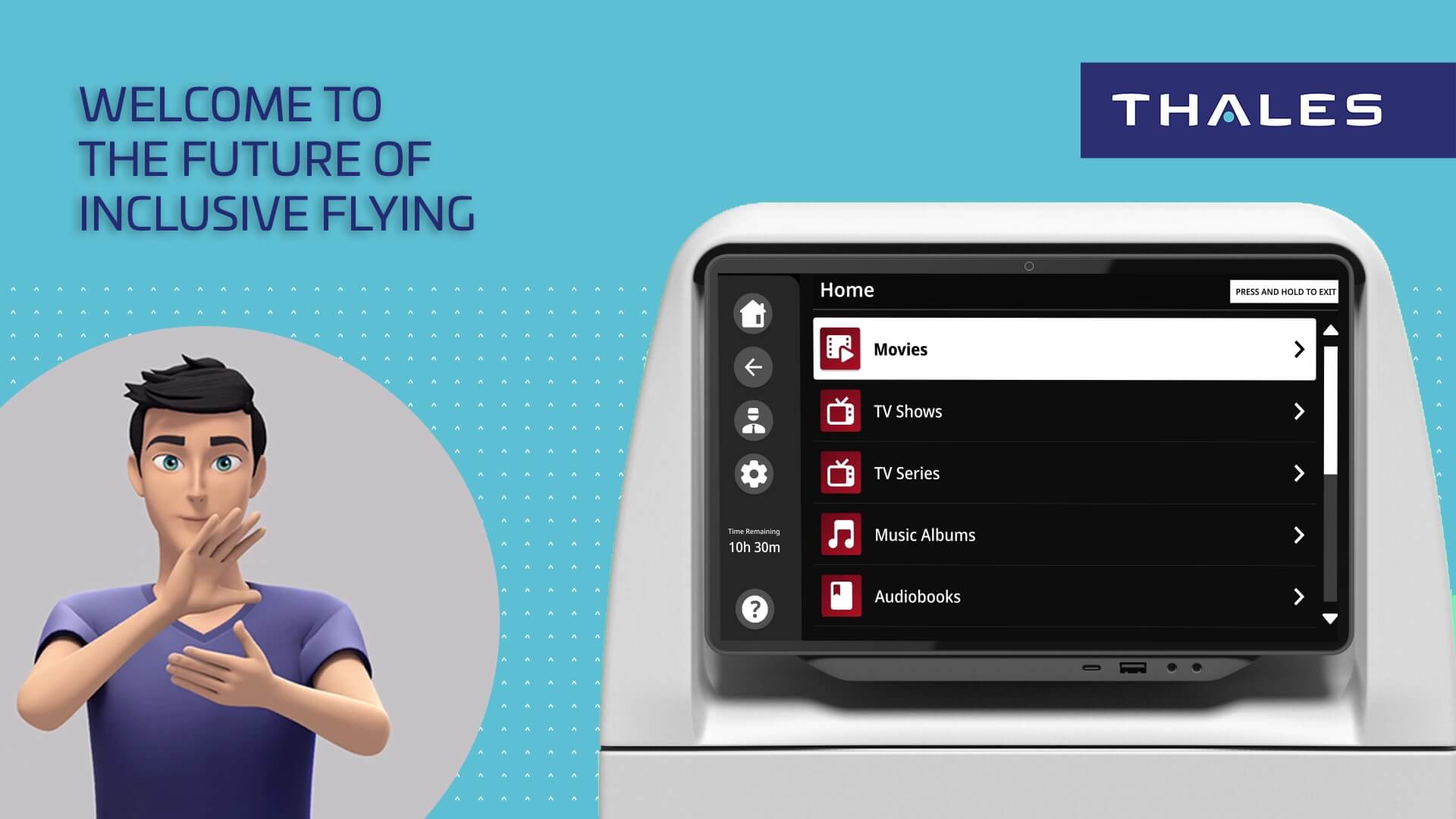
Thales is also working on accessibility needs beyond low vision or blindness, including a signing avatar in multiple languages
A key feature of Thales’ innovation demonstrations is already flying today: the User Interface (UI) for visually impaired passengers. Developed in partnership with American Printing House, which is the world's largest nonprofit organization dedicated to creating experiences for those who are blind or near blind, Thales worked with experts to make this UI a reality. Currently, it is flying on Emirates, American Airlines, and soon on other leading North American carriers.
When a passenger with special needs goes through the UI for the first time, it speaks directly to them, guiding them through the airline’s IFE system without help from the cabin crew. To navigate through the UI, passengers can use a series of up to 13 different swiping and tapping motions that are globally recognized and akin to those used to navigate on a smartphone or tablet. It creates a seamless transition from being on the ground to being in the air for those who are blind or have low vision.
The UI featuring 13 intuitive accessibility gesture controls was recognized by the industry with a 2024 Crystal Cabin innovation award.
“There has been a lot of positive feedback and I think it is because accessibility has been kind of an afterthought within the industry. We are really trying to be humble innovators by breaking new grounds for those who might not be so spoken for,” says Stuart. “It is an audience that has not been catered to so much in the past.”
One of Thales InFlyt Experience’s key missions is to develop solutions to make the inflight journey more accessible and enjoyable for all. As such, Thales is also working on accessibility needs beyond low vision or blindness, including a signing avatar in multiple languages, customized for airline requirements.
Visitors to Thales Irvine can experience first-hand this avatar, which helps communicate certain nuances and gestures in sign language that do not translate to a subtitle.
Using this avatar is not just for trailers or movies –it could also be used for safety videos and announcements. Around 70 to 80 percent of the signing is AI-generated and the rest is manually fine-tuned with a specific QA/QC process.
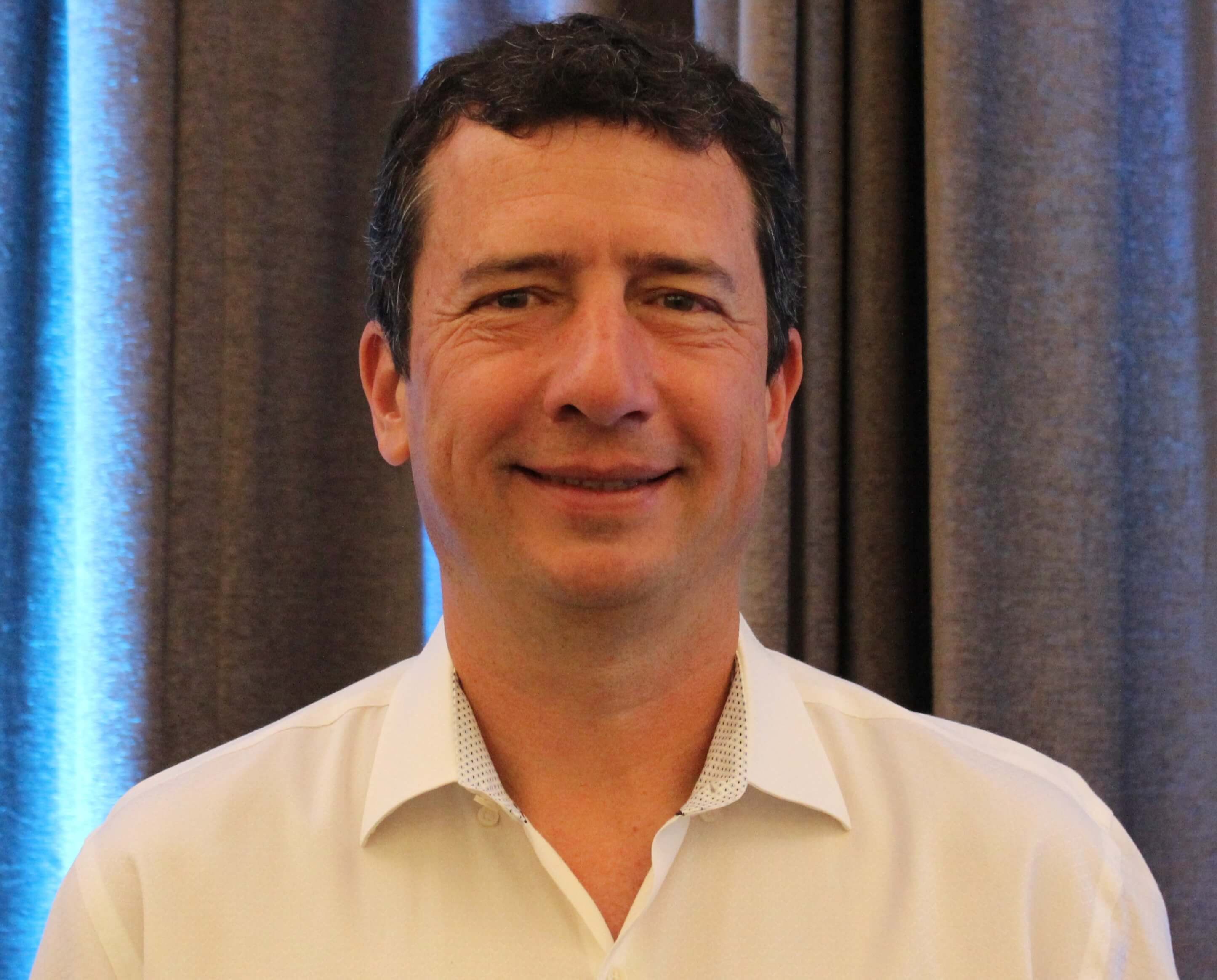
Tudy Bedou, Chief Technology Officer of Thales InFlyt Experience
As a result, airlines will be able to customize the avatar to meet specific requirements and align with the carrier’s branding.
“Accessibility is a cornerstone of what we do at Thales. We continue to invest in research and technologies to expand our suite of IFE accessibility solutions to meet the needs of all passengers,” says Tudy Bedou, Chief Technology Officer of Thales InFlyt Experience. “We have broadened our ecosystem of partners including OEMs, airlines accessibility teams, and Subject Matter Experts to ensure our products and services truly create an enjoyable experience for all.”
Creating space for cabin innovations
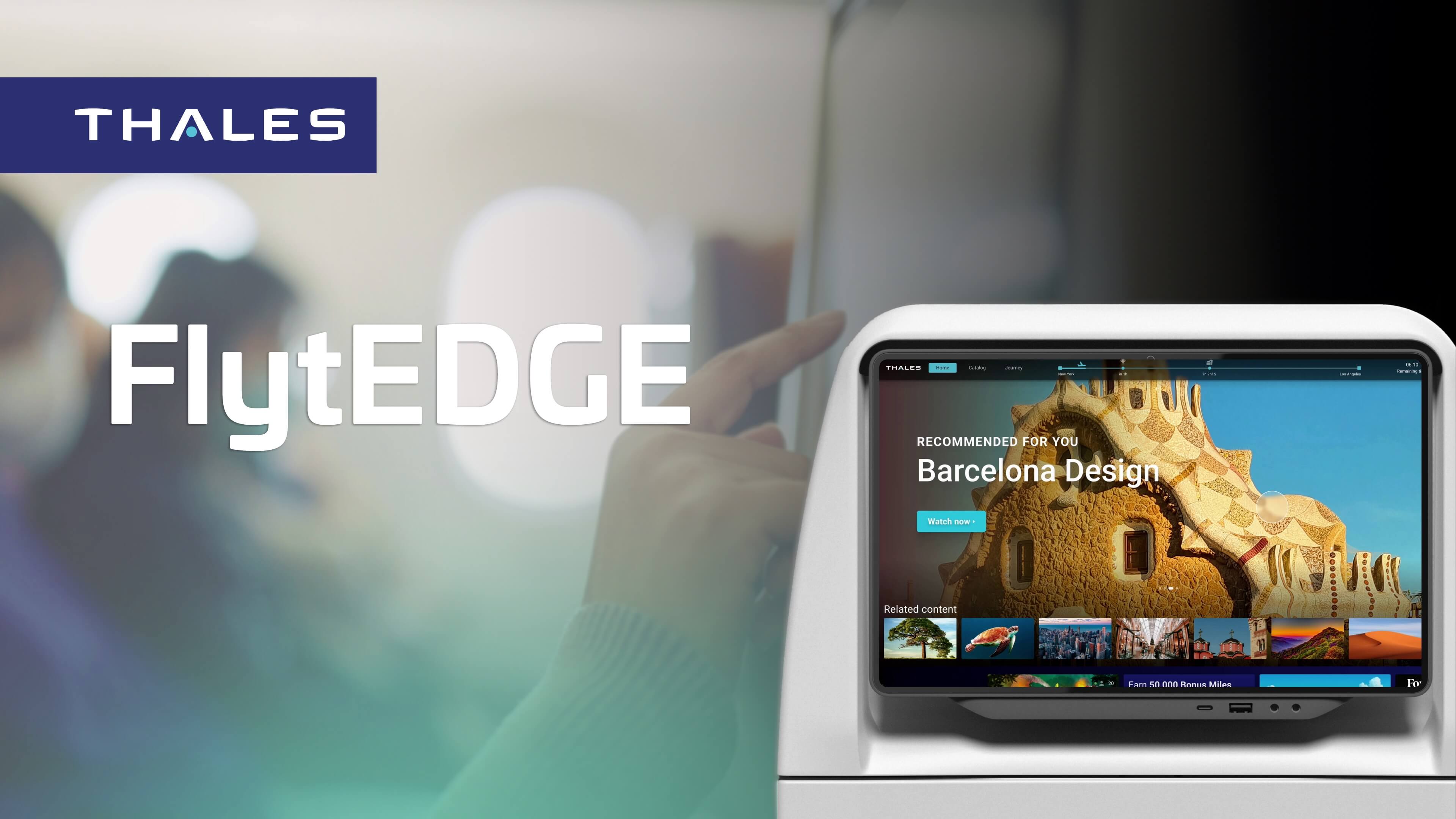
FlytEDGE is designed to help airlines deliver an experience that is individually tailored to each passenger
Among the developing cabin innovations at Thales is FlytEDGE, a first-of-its-kind IFE platform that was unveiled at AIX 2024. Designed to help airlines deliver an experience that is individually tailored to each passenger, FlytEDGE uses a connected cloud-native architecture to increase airlines’ flexibility to rapidly bring passengers any web-based service. Beyond that, it is powered by the Onboard Data Center (ODC), a 2023 Crystal Cabin Award winner, enabling airlines to effortlessly manage content updates in real time.
Leveraging the high-performance computing capabilities of the ODC, Thales is showcasing a speech-to-text prototype whereby the system can transcribe announcements in real time made by flight attendants. These announcements can then be displayed as on-screen text for passengers who are hearing impaired or need the announcement translated into another language. This feature is supported by Artificial Intelligence technology.
Thales also envisions advancements in onboard retail to enhance Business Class immersive experiences, with concepts in development. Thales is collaborating with AR/VR providers to showcase new experiences such as gaming, shopping and immersive content in premium cabins. Other concepts shown by Thales on their Business Class Technology Demonstrator are an electronic light-up paint, a glasses-free 3D experience and a seat integrated with haptic feedback.
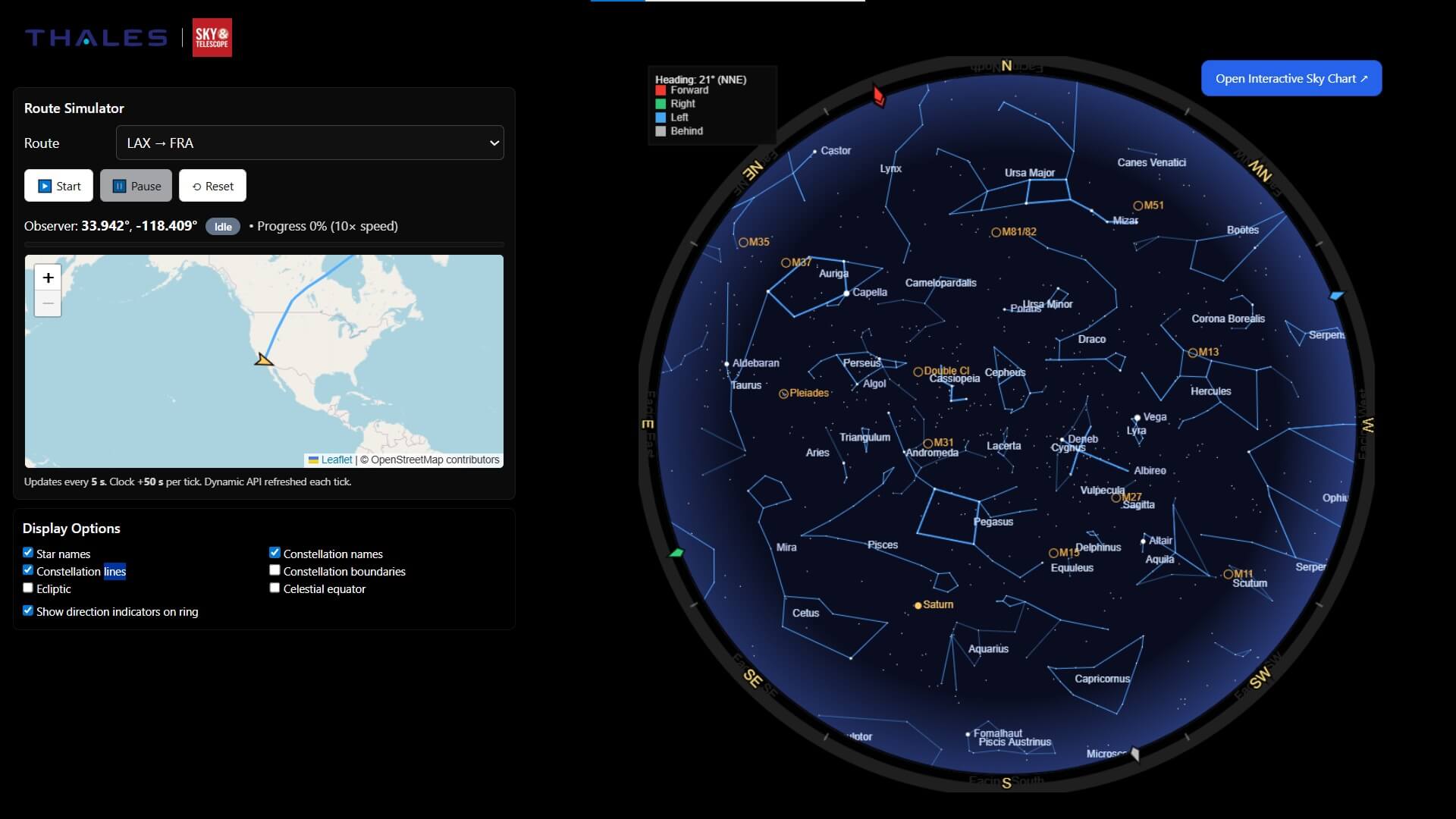
Thales's InFlytSky map concept acts as a flight map, but shows the aircraft's location in relation to the sky
Interestingly, Stuart, who is an amateur astronomer, is bringing her passion and quest for knowledge about the galaxy to the cabin concepts at Thales, with the InFlytSky map in partnership with Sky & Telescope. This concept acts as a flight map, but instead of tracking the aircraft’s whereabouts in relation to the ground, it allows them to see their location in relation to the sky and learn about various planets and constellations in the process. Thales demonstrates this application on a 17”, in-arm foldable display prototype integrated into a front row seat at its Irvine facility.
“At Thales, we anticipate the needs of our customers and their passengers; this inspires our spirit of innovation. Our commitment to understanding the entire travel journey is what keeps us at the forefront of technological innovation and allows us to consistently deliver game-changing experiences,” says Bedou.
