
FlightPath3D redefines role of moving map in connected cabin
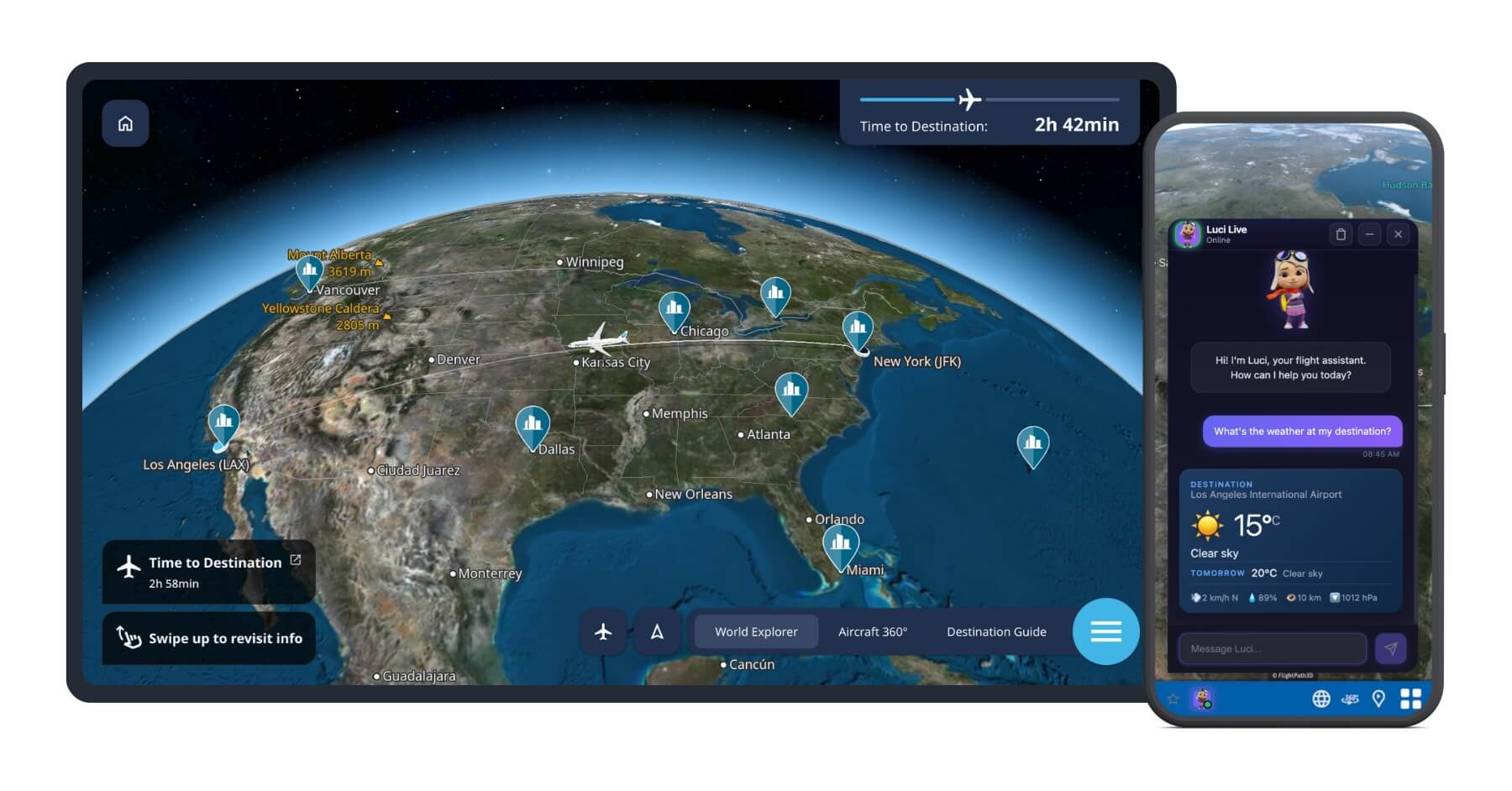
FlightPath3D emphasizes that the cabin is no longer a single-screen environment, citing that 85 percent of passengers travel with at least one personal device
As airlines invest in high-speed, Low Earth Orbit (LEO) connectivity, the conversation is evolving beyond bandwidth in the cabin to how effectively that connectivity engages passengers throughout their journey. In its June white paper “The Connected Cabin Inflection: What Happens After the Pipe,” FlightPath3D argues that the greatest return on investment for carriers is not the satellite, but the software layer that shapes the passenger experience.
In the report, FlightPath3D examines the question more airlines are asking as LEO connectivity changes how passengers engage with content and devices onboard. Once the passenger is connected to high-speed Wi-Fi, how does an airline keep them engaged with the digital ecosystem that drives ancillary revenue?
“An airline pays for the pipe, and the passenger uses it to leave the airline's ecosystem entirely,” the report reads, highlighting that, at the same time, passengers are also struggling with a related pain point. They are demanding more information about their destination, connections, baggage and more.
The white paper presents the moving map as the only digital surface in the cabin with 100 percent relevance to all passengers, proposing that the modern moving map must evolve into a connected digital experience spanning the seatback, PEDs and airline portal.
As FlightPath3D President Duncan Jackson tells PAX Tech in July, the software layer is where airlines have the opportunity to redefine the connected passenger experience and maximize the value of the connectivity investment.
Dual screens duel for passenger attention
In its report, FlightPath3D emphasizes that the cabin is no longer a single-screen environment, citing that 85 percent of passengers travel with at least one personal device. This shift allows them to engage with the flight map on the seatback while simultaneously scrolling on their phones, or scanning a QR code to extend the seatback experience to the PED.

Duncan Jackson, President, FlightPath3D
“To help airlines keep passengers engaged, we need to go beyond basic flight tracking and answer questions like, ‘What should I do when I land?’ ‘Where is my connecting gate?’ and ‘Where do I go for rideshare pickup?’ To do that, we are focused on building software for passengers that addresses their entire journey from gate to gate, and works across every screen,” Jackson explains.
He points to FlightPath3D’s products like Luci Flight Companion, Destination Stories and Reels as examples of enhancing the 3D moving map to achieve that reality.
“The map is the most-watched digital surface in the cabin. When looking at 500 aircraft, we see passengers spend an average of 55 minutes on the seatback map per flight, 18 minutes on the mobile map. This stickiness presents an opportunity to create continuity in both the map experience and airline brand presence across both screens,” explains Jackson. “Lean back with an immersive 3D map filled with cinematic views on seatback and lean-in interactions like exploring destinations and things to do via Reels on mobile.”
Layer by layer
The white paper highlights the various touchpoints where a moving map is most likely to engage passengers. This includes the map showing destinations travelers are flying over during the climb, to suggestions of what to see and do at a destination while at cruising altitude, to critical information about baggage claim and connections during descent and arrival.
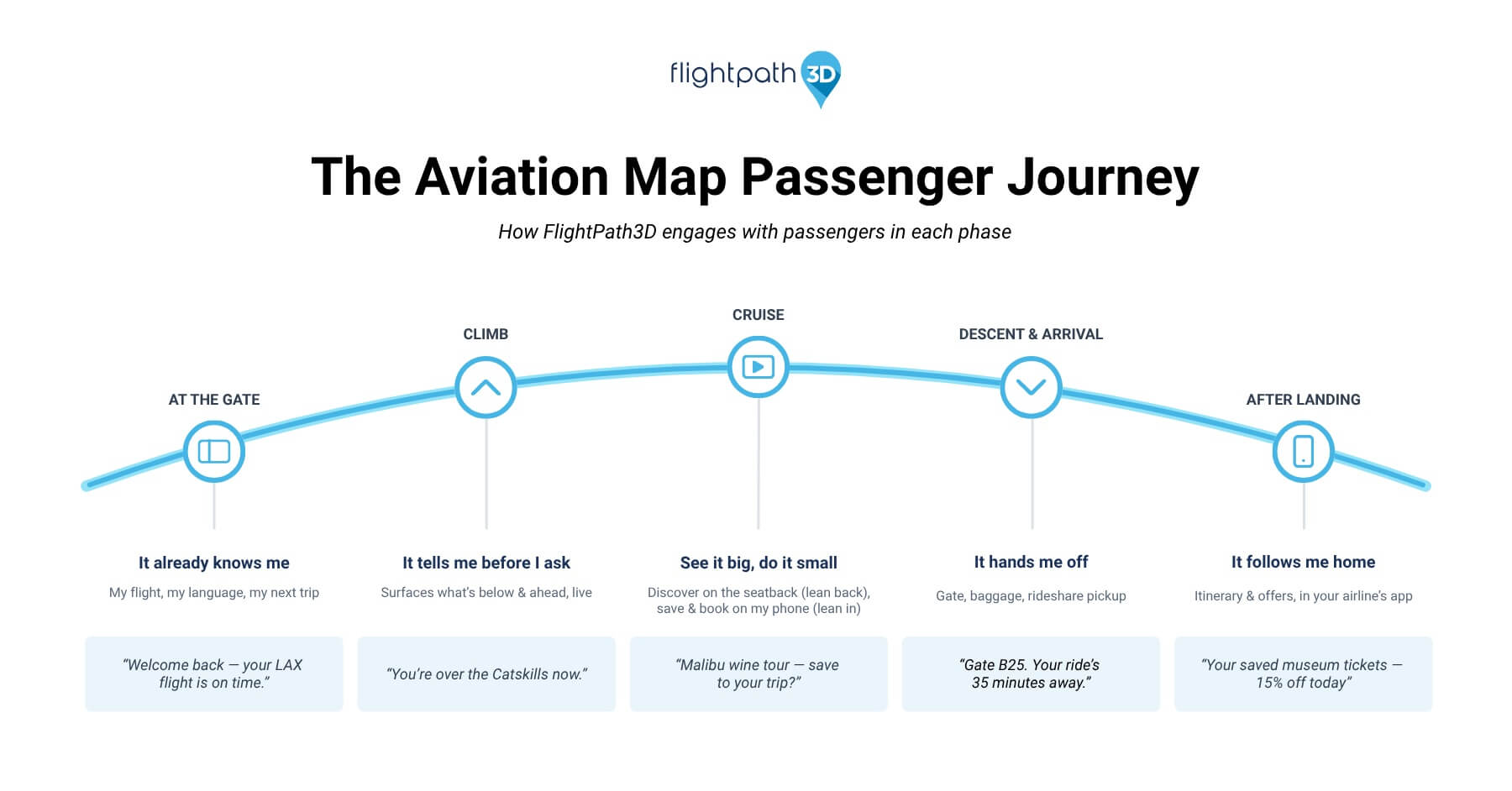
The white paper highlights the various touchpoints where a moving map is most likely to engage passengers
FlightPath3D identifies the four underlying operational layers that can reshape how passengers engage with the inflight connectivity as Data, Content, AI and Deployment, noting that most map vendors solve only one of these. FlightPath3D, however, is addressing all four layers by understanding the moving map as more than a flight tracker with features to be added later. It treats the map as a cohesive platform, calling it the “connective tissue of the cabin software stack.”
According to Jackson, delivering a seamless flight map requires three critical data layers: live aircraft telemetry and flight schedules, geopolitical intelligence and airline network data—combined in real time through proprietary algorithms for interpolation, predictive processing, caching and rendering.
Addressing the content layer, Jackson explains that stock footage does not work, so FlightPath3D has built a rich visual library, covering more than 100,000 points of interest with 25,000+ videos, that is commercially licensed, brand safe and curated for the inflight experience.
“We launched our Luci Flight Companion in 2023 that uses AI to provide travelers with contextually relevant, dynamically curated content,” he says of AI’s role in the platform’s operation. “This year, we launched Luci Live extending that foundation into a real-time, two-way conversation offering narration of the inflight journey.”
As for the deployment layer, Jackson notes that airlines often operate multiple IFE platforms, connectivity providers and passenger touchpoints, so FlightPath3D delivers a consistent experience across every device, platform and aircraft in the fleet.
“The map is one of the highest-attention surfaces and when you address all four of these layers like we do, airlines get a map that works across the entire connected passenger journey becoming a vital piece of their loyalty and revenue strategy,” he says.
The paths ahead
As airlines embrace LEO connectivity, FlightPath3D’s report points to three potential paths forward for the digital architecture carriers integrate in the cabin.
The first is to default to the connectivity vendor's standard interface defining the cabin experience and accept the limits that come with it. The second is to add a few “connectivity-aware features” to a standalone flight tracker. But the third option, and the one FlightPath3D urges airlines to pursue, is to “build for the era the cabin is entering.” For the carrier, this looks like choosing the platform that turns connectivity into branded passenger experiences, monetizes bandwidth and extends the digital journey.
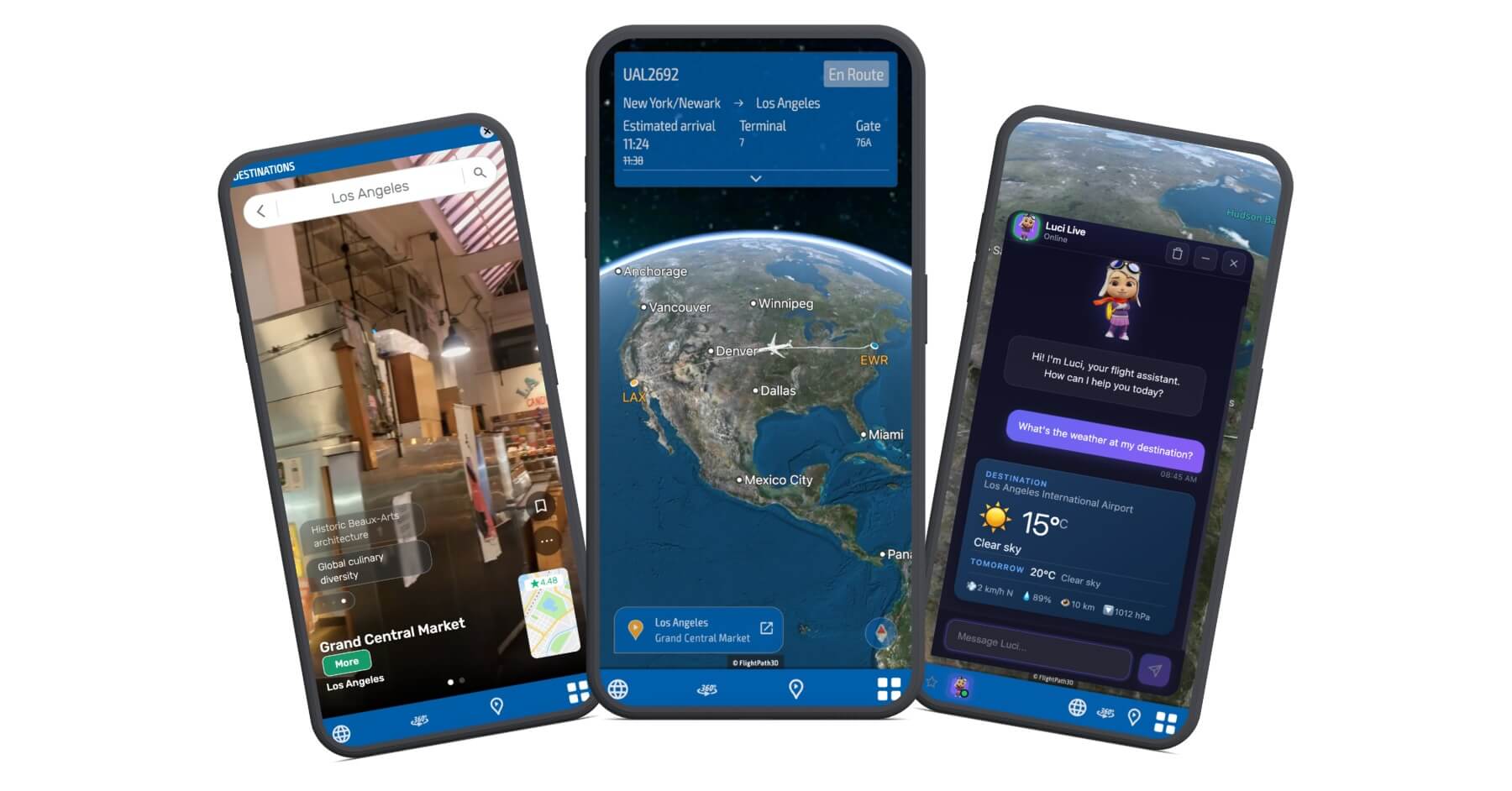
FlightPath3D’s products like Luci Flight Companion, Destination Stories and Reels are examples of enhancing the 3D moving map to engage passengers at all stages of the journey
“As airlines invest in next-generation connectivity, we are helping them maximize that investment by ensuring the passenger experience evolves alongside the network. The winners will not just have faster Wi-Fi—they will have a compelling digital experience that gives passengers a reason to use it,” Jackson tells PAX Tech.
FlightPath3D’s report concludes by emphasizing the immediacy with which decisions on inflight connectivity and entertainment must be made, as the decisions today affect the long-term passenger experience and “define the connected cabin for the rest of the decade.”
For airlines to ensure maximum ROI on connectivity investments, Jackson underscores the importance of thinking beyond the capacity of LEO connectivity and instead focusing on how passengers can remain engaged with the airline’s portal throughout their entire journey.
“Connectivity alone is not the strategy—it is the foundation. The airlines that maximize ROI will be the ones that pair next-generation connectivity with a compelling digital passenger experience that drives engagement, loyalty and ancillary revenue,” he concludes.
